

[Breaking] The Unconstitutional Ban on Social Media for Under-15s
Not even the kings of France, nor the Catholic Church, thought to ban books for minors after Gutenberg's press unleashed the written word on the masses. This law is headed straight for legal purgatory

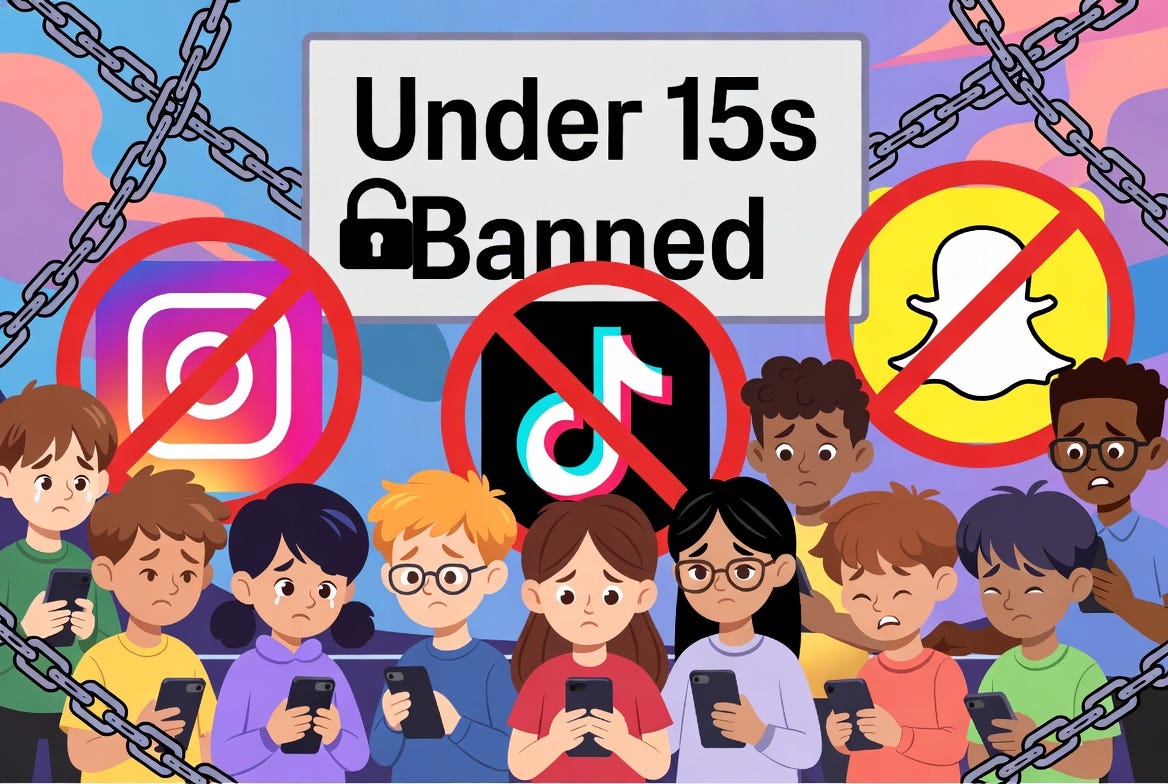
The French National Assembly has passed the law banning under-15s from social media — a law that will require all users to verify their identity, thereby opening the door to illegal mass surveillance. Instead of reacting like Pavlov’s dogs, let’s think for a moment: this isn’t the end of free speech, but a text drafted with the left foot by clowns — and given the size of the shoes...
Note that National Rally MPs voted for it or abstained. This just goes to show there’s not much to expect from that party — no more than from the rest of the French political class — unless the people put a gun to their heads, figuratively, one hopes.
![[ Editorial ] Change Is Soon? Not Quite](https://substackcdn.com/image/fetch/$s_!9op8!,w_140,h_140,c_fill,f_webp,q_auto:good,fl_progressive:steep,g_auto/https%3A%2F%2Fsubstack-post-media.s3.amazonaws.com%2Fpublic%2Fimages%2Ff50fab19-4672-4a9e-a222-2c4003938af6_1248x832.png)
This kind of law has already proven its uselessness elsewhere. Take Australia. A study by the University of Newcastle, published in the British Medical Journal, showed that more than 85% of minors gleefully circumvented the ban. Among the various methods used, 9 to 29% used someone else’s account, 15 to 19% created a fake account with a false age, and 6 to 11% went through private browsing and VPNs.
In the United Kingdom, a government survey (BMG Research for the DSIT), conducted among 2,299 children aged 11-17, showed that nearly two children out of five (39%) managed to bypass online age verification, and more than half deliberately choose sites, apps, or games specifically to dodge such checks.
Let’s not be told this is about protecting children, who are the sole responsibility of their parents. This is about filing the entire population and banning online anonymity — even though French courts reaffirmed in September 2025 that speaking anonymously online is perfectly lawful (Paris judicial tribunal, September 19, 2025, No. RG 25/51051, Wikimedia Foundation case).
Worse, the law that was passed is very likely unconstitutional. Freedom of expression and communication doesn’t wait for a certain number of years to kick in — it runs from birth. Minors enjoy them under the supervision of their parents. This law restricts a category of individuals’ freedom of speech on shaky grounds — a report from the National Health Safety Agency claiming social media is dangerous for children’s mental health. What they put kids through during Covid, of course, doesn’t count. And it does so with zero proportionality, since it bans all minors under 15 from all social media, full stop.
An analysis published by Le Club des Juristes points to a paradox: the adopted text amounts to nothing more than a statement of principle (access is banned for minors under 15) with no concrete enforcement mechanism attached to it — much like the “digital majority” provision in the Marcangeli law, which remained a dead letter for lack of any implementation tool. These legal scholars believe that, precisely because there’s no practical mechanism, even a referral to the Constitutional Council would struggle to find it unconstitutional, for lack of any concrete issue to rule on — but that such a referral would delay the law’s entry into force, currently planned for the start of the school year (September 1, 2026, for new accounts) regardless.
So the law that was just passed serves no purpose whatsoever, other than to scare people and harass the entire population. It will stay in limbo. Emmanuel Macron and his government are banking on the adoption of EU-wide measures to actually implement this ban — which isn’t about to happen anytime soon. As La Quadrature du Net, a online free speech activist organization, points out, Article 28 of the Digital Services Act specifies that it does not require platforms to process additional personal data to determine whether a user is a minor — whereas an age-verification requirement does exactly the opposite, forcing the processing of extra data on everyone in order to exclude minors.
Article 28 of the DSA — Online protection of minors
Providers of online platforms accessible to minors shall put in place appropriate and proportionate measures to ensure a high level of privacy, safety, and security for minors on their service.
Providers of online platforms shall not present advertisements on their interface based on profiling, as defined in Article 4(4) of Regulation (EU) 2016/679, using personal data of the recipient of the service, when they are aware with reasonable certainty that the recipient is a minor.
Compliance with the obligations set out in this Article shall not oblige providers of online platforms to process additional personal data in order to determine whether the recipient of the service is a minor.
The Commission, after consulting the Board, may issue guidelines to help providers of online platforms apply paragraph 1.
In short: Emmanuel Macron and his government have no idea what they’re doing, and the members of Parliament don’t understand what they’re voting for. Yet another PR stunt from the tenant of the Élysée that just fell flat on its face — like a cowpat dropped straight from the cow’s rear end.
Where things take an amusing turn is in reading the letter from Marc Guillaume, the new head of the Conseil d’État, France’s highest administrative court also acting as councel to the government, addressed to the Secretary-General of the government.
In this letter, the Conseil d’État states that it did not have sufficient information to formulate its advisory opinion, because the government failed to provide it. So we’re in for a good laugh when the implementing decrees of this law come up for judicial review — where the Conseil d’État will be able to strike them down on grounds of non-conformity with EU law, namely the DSA.
Let’s repeat this in other words: the ban on social media for under-15s will inevitably be illegal in its application, since it contravenes the DSA — that infamous European regulation whose primary goal is to control online speech — and the same fate awaits any attempt to impose it top-down at the European level. Proud to be amateurs!
This once again confirms what we’ve been saying for over six months: the senior judiciary and part of the senior civil service are no longer playing along with the schemes of Macronism and the centre. They can no longer stomach the legislative riders, the mess, the erosion of the legal order, and the generalized insecurity created by incompetents obsessed with controlling speech — who now have no way left to tip the scales in their favor for the 2027 presidential election.
If you’d like us to keep doing our work and producing original reporting — which we do for you, dear readers — then subscribe. Because a commitment to journalism, which doesn’t aim to shape public opinion but to inform the public, doesn’t put food in the fridge. No one can live indefinitely on love and cold water alone, however strong the passion carrying them.