No more Reuben sandwiches at Katz’s for Thierry Breton—apparently even New York’s most legendary deli now joins the list of places closed to the censors of Europe.
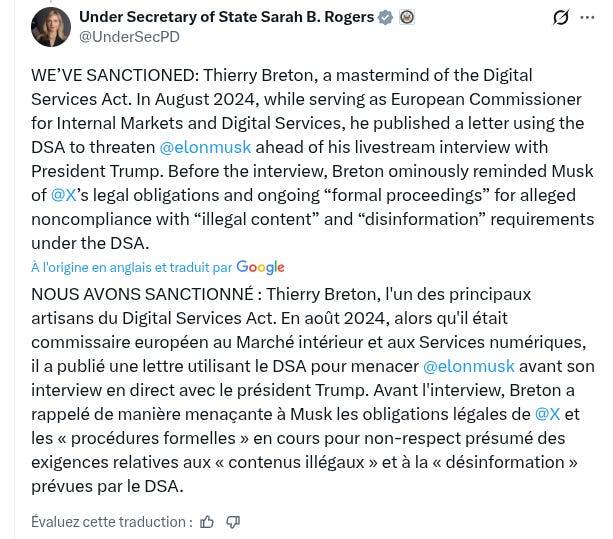
The European establishment is clutching its pearls, howling about the “censorship” of Thierry Breton. Let’s be clear: the United States isn’t gagging him. Breton is free to speak as much as he likes—just not from U.S. soil, where he’s no longer welcome. That’s not censorship.
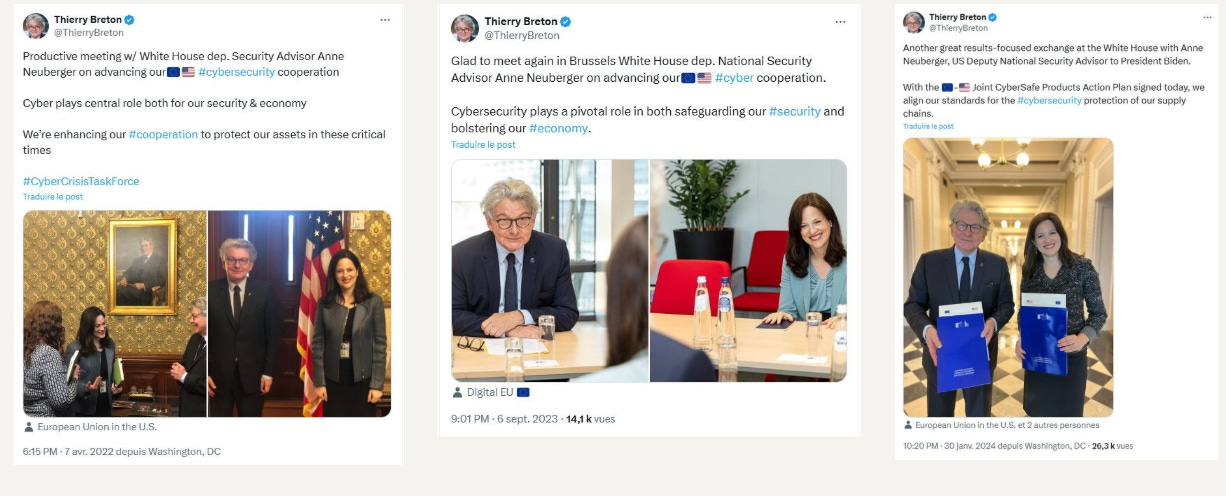
And one wonders why Thierry Breton, European Commissioner for the Internal Market, met so regularly with Anne Neuberger, then deputy national security adviser to Joe Biden and former deputy director of the NSA under Barack Obama. The Trump administration has access to the archives—every last one of them, including those stamped top secret. Insititutional memory, it turns out, can be a dangerous thing.
Let’s say it again, slowly, for those pretending not to hear: Europe’s “censorship-industrial complex” did not emerge organically. It was installed on demand—first under the Obama administration starting in 2015, then reinforced under Biden from 2021.
As for the DSA, it is a bureaucratic monstrosity in search of a justification. Europeans never needed it. Since the 2000 E-Commerce Directive—and in France the LCEN of 2004—we already had clear, workable mechanisms to remove content that is manifestly illegal, with the judiciary as the final arbiter. What the DSA adds is not protection, but power: power stripped from courts and handed to administrators, regulators, state funded NGOS and platforms eager to over-comply. That isn’t progress. It’s regression dressed up as safety.
The Citizen's Survival Guide to the Digital Services Act (DSA).

Survival Guide to the DSA, for the scrappy and the whiny alike, so the scrappy can bite harder, and the whiny finally run out of excuses to whimper.
The very logic of the censorship-industrial complex—where the State silences speech it finds inconvenient by outsourcing repression to NGOs it bankrolls—was not improvised yesterday. It was pioneered in France with the 1972 Pleven Law, engineered by the French left and two obliging auxiliary NOGs, LICRA and MRAP.
This model, now presented as a moral necessity, was already a political weapon then, and we documented its genealogy in the Twitter Files France. What has changed since is not the method, but the scale: yesterday a national experiment, today a fully industrialized system of speech control, polished, normalized, and exported.
The DSA was engineered as a workaround: a convenient way to subcontract to Brussels the censorship of American citizens—speech that cannot be suppressed on U.S. soil thanks to the stubborn inconvenience of the First Amendment.
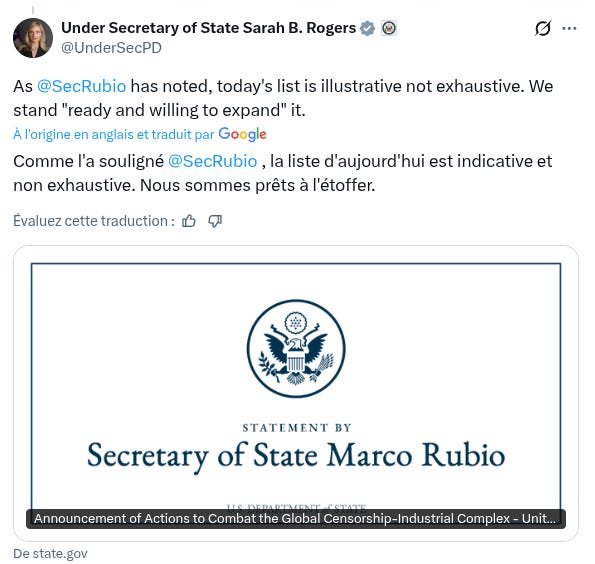
Unsurprisingly, it is this NGO-mediated machinery that the Trump administration is now going after, starting with a first list of five names. The message is blunt: those who helped build and operate the offshore censorship pipeline are no longer welcome in the United States. When censorship can’t cross the Atlantic legally, it seems, consequences can.
The message from Washington could not be clearer. This is a warning shot across the bow—one that, for now, carefully avoids European and British officials.
But no one should mistake restraint for hesitation. The State Department is making it known that the list can grow, and fast, if business continues as usual. In other words: the next round may come with names that carry titles, not just NGO letterhead.