

"I Have Serious Doubts About The Quality of European Democracy"
Whether to negotiate with Russia cuts deeper than a mere political disagreement. L'Eclaireur sat down with Luxembourgish MEP Fernand Kartheiser to explore what it really reveals

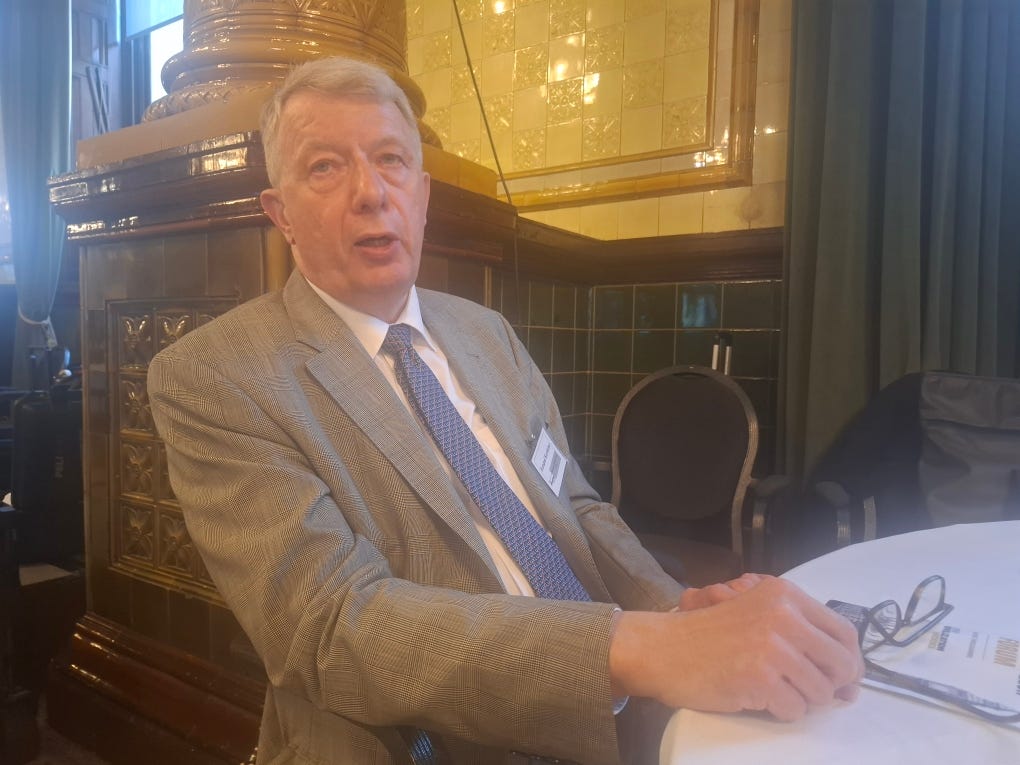
Is there not something faintly absurd about European Parliament President Roberta Metsola of Malta launching a disciplinary investigation into Luxembourgish MEP Fernand Kartheiser on the grounds of the EU’s code of conduct?
The former ambassador stands accused of maintaining contacts with Russian authorities — through meetings and exchanges — a stance that ultimately cost him his seat in his parliamentary group. More recently, he attended the St. Petersburg International Economic Forum and signed a cooperation declaration with the Russian parliament.
But can a lawmaker genuinely be accused of undermining the political message of an institution he does not claim to represent, by disregarding a rule that does not exist? There is no written prohibition on engaging with Russian interlocutors simply because the EU has placed them under sanctions.
Since his election, Kartheiser has held consistently to the same position: he acts in a personal capacity, within the freedom afforded to any elected representative. He has never claimed to speak for the European Parliament. In his view, he answers to his voters — not to the institution itself.
Back-channel diplomacy? That is a fair question to ask. What makes the affair particularly farcical, however, is the light shed on it by recent developments within the EU itself. While the European Parliament has shut the door on any engagement with Moscow, others have been quietly opening it.
On June 19, European Council President António Costa announced the establishment of what he called a “diplomatic channel” with the Kremlin, intended to gauge whether conditions for peace negotiations might exist. He reportedly did so without consulting all 27 member states — Estonia was notably opposed — and without informing the European Commission in advance. The European Parliament was not consulted either.
The Kartheiser affair, then, is about far more than a clash between an MEP and his institution. The debate over whether to negotiate with Moscow is merely the visible symptom of a much deeper malaise. Divisions are emerging not only between EU member states — particularly along the sharpening East-West fault line on Russia policy — but within the European institutions themselves.
What is truly at stake is a struggle for diplomatic legitimacy among the EU’s three centres of political authority: the European Council, the European Commission, and the European Parliament. The underlying question is both simple and explosive — who actually speaks for Europe in its dealings with Russia, especially when Moscow has made clear it does not want the EU at any future negotiation on Ukraine?
This ambiguity has never been resolved by the EU treaties. The Treaty on the Functioning of the European Union distributes responsibilities across the European Council, the High Representative for Foreign Affairs — currently Kaja Kallas, a figure of growing controversy in some circles — and the European Commission, yet it designates no single diplomatic authority. The tensions now surfacing are exposing precisely that institutional fault line.
All of this we discuss with Fernand Kartheiser.
