[ Mass Surveillance ] The Return of the Black Box
Backdoors granting plaintext access to encrypted messaging are a technical impossibility — short of catastrophically undermining the security of everyone, governments included.

“Organised crime is either illicit commerce — with flows of goods on one side and corresponding flows of money on the other — or illicit services — with flows of, say, sexual services on one side and the resulting money flows on the other. Targeting the revenues of criminal enterprises and their financial flows is judicially far more effective than focusing on intercepting their merchandise, which is primarily the job of customs with regards to transational narcotics traficking.”
The DGSE - the French foreign intelligence agency - does whatever it pleases when it comes to intercepting communications abroad. Logical enough, since the DGSE’s very function is to collect foreign intelligence through illegal means. That’s the job description — no one pretends otherwise.
The agency that perennially poses a problem is, as ever, the DGSI (domestic intelligence)— born from the merger of the Renseignements généraux (RG) and the Direction de la surveillance du territoire (DST), two outfits notorious for their excesses: manipulation, dirty tricks, and cheerful subservience to whoever happens to be in power.
Today, the DGSI is twice the problem it once was. It still carries the original sins baked into the DNA of the RG and the DST. And now it has acquired a fresh dependency, no less alarming: Palantir. Gotham, to be precise.

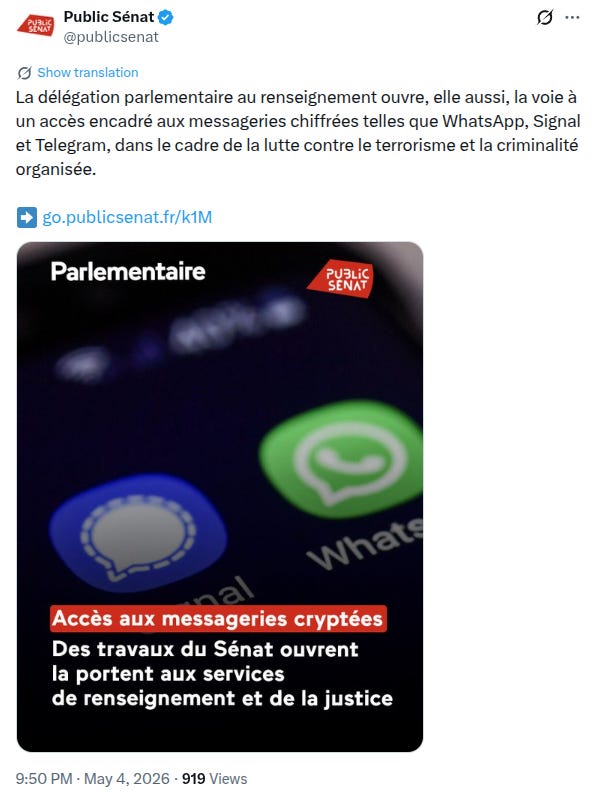
You may recall the Bruno Retailleau episode: then-Interior Minister, he attempted to strong-arm encrypted messaging platforms into surrendering their communications in plaintext — on pain of a fine amounting to 2% of their revenues — through his anti-narcotrafficking bill.
Our colleague Régis de Castelnau, a lawyer by trade, has already given M. Retailleau a thoroughly deserved piece of his mind. Retailleau, a senator who harbours presidential ambitions in 2027, has just shepherded through the Senate a truly villainous piece of legislation enabling the French Ministry of Fiance to freeze — for six renewable months, without so much as a court ruling — the assets of any legal entity or private individual deemed to be “spreading hatred.”
Allow us, now, to fill in the rest of the picture.
It must be said: the idea of hoovering up data straight from the source — the messaging platforms themselves — originated with Macronist deputy Cédric Perrin, chairman of the Foreign Affairs Committee, who delivered himself of the following verdict, as confident as it was hollow: “I fail to see what difference there is between what is done today with SMS and email and what would be done tomorrow with WhatsApp, Signal and Telegram.” Except that WhatsApp, Snapchat and Telegram have precisely little in common with SMS or email — and anyone who takes security seriously has long since migrated to metadata-free encrypted messaging services such as Proton. End-to-end encryption is not a paranoid luxury: it is a foundational pillar of cybersecurity for society as a whole.
Staggering in its stupidity — technically, economically, and of course from a security standpoint — the measure was, mercifully, resoundingly rejected by the National Assembly.
But of course, they were never going to leave it there.
Earlier this year, Prime Minister Sébastien Lecornu tasked deputy Florent Boudié (Ensemble pour la République), chairman of the Law Committee, with exploring the legal avenues that would allow investigators and intelligence services to access encrypted communications under certain conditions.