

The DSA Is a Failure
Europe's much-feared Digital Services Act is regulatory theatre — bloated, toothless, and tailor-made for scaremongering. Two year after it came into force, the DSA has no effect in France.

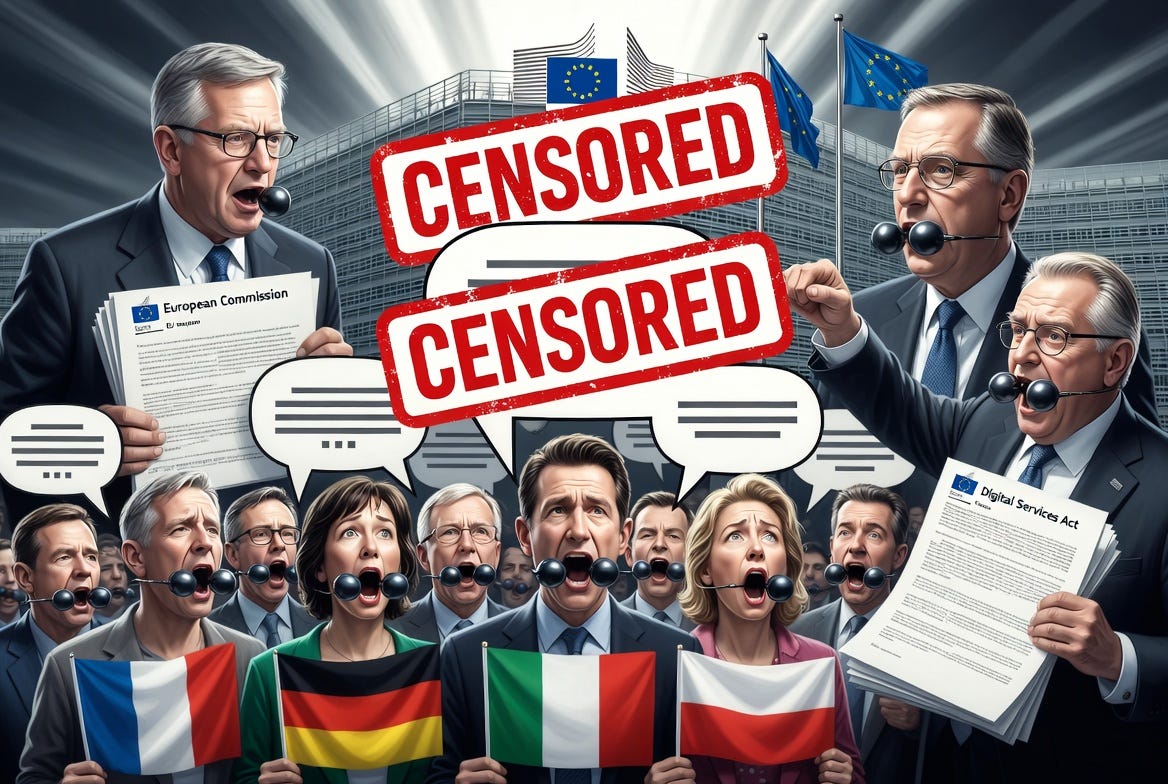
Here we go again. Another round of collective hysteria.
On one flank, self-styled champions of the “new world” desperately clinging to the old one that handed them power — like Macronist MP Paul Midy, who wants to apply François Hollande’s notoriously rigged airtime rules to social media, allocating speaking time based on previous election scores. Imagine the 100-metre Olympic final where the defending gold medallist gets a 30-metre head start. That’s the logic.
On the other flank, a significant chunk of the French independent press and influencers — driven partly by ideology, partly by the appetite for effortless engagement — are drowning their audiences in apocalyptic warnings about the censorship allegedly enabled by the DSA. Like the mainstream media they claim to oppose, they're playing the oldest trick in the book: weaponising fear for clicks, thus nudging toward self-censorship.
As the 2027 elections draw closer, expect this to get considerably worse.
Some necessary history.
The Twitter Files France exposed the distinctly French origins of the privatisation of criminal prosecution in free speech matters — a tradition stretching back to the 1972 Pleven Law. Then came the Avia Law of June 2020, designed to force near-instant removal of terrorist and child abuse content, and 24-hour takedowns of “hateful” content on major platforms. The Constitutional Council struck it down on two grounds: it unlawfully outsourced judicial oversight of free expression to private companies whilst it is the prerogative of the judiciary, and its leadtimes and penalties were so extreme they would inevitably trigger mass deletion of perfectly legal content.
The DSA entered into force in March 2024. It changes nothing. The eight organisations currently holding “trusted flagger” status in France cannot order the removal of a single piece of content, they have no authority to do so. They can flag it. Platforms are then obliged to examine those flags within a reasonable timeframe — an obligation of means, not results. That’s it.
The selection of those eight organisations — curated under Minister Aurore Bergé — tells you everything about who actually governs France. Each group guards its designated cardinal sin: racism, islamophobia, antisemitism, homophobia, “masculinism,” and so on. In a republic where every citizen is equal before the law, there are officially no minorities — yet these NGOs, generously funded by the governement thus conveniently pliable, have been handed the mandate to speak for communities they don’t actually represent (refer also the Twitter Files France).
French courts have already spoken.
Three landmark rulings with regards to DSA enforcement, all from the Paris tribunal, all delivered within 16 days of each other in autumn 2025:
In the “Point Sun” case (3 September 2025), the court ruled that filing a complaint does not establish that disputed speech is illegal, and that under the DSA a critical video posted on TikTok shall not be suppressed. Personal, subjective testimony falls within admissible criticism.
Two days later, a related ruling (5 September 2025) reaffirmed the foundational principle: freedom of expression is the rule; restrictions of speech require concrete, proven, manifest illegality. Courts shall not transform platforms or any other organization into arbiters of public discourse.
Then came the Wikimedia Foundation case (19 September 2025), where a litigant attempted to weaponise DSA compliance obligations against Wikipedia. The court declared the claim inadmissible: only Arcom (the Digital Services Coordinator and French broadcasting regulator) and the European Commission hold supervisory competence under the DSA, as it is administrative. The ruling further enshrined the primacy of free expression and the right to information over the right to erasure and oblivion, and confirmed the protected anonymity of Wikipedia contributors.
Sixteen days. Three unambiguous verdicts. The message is consistent: criticism is admissible; illegal speech requires proof thereof and cannot be restricted otherwise; only courts can order the takedown of content; freedom of expression and right to information prevail; anonymity is legal.
That is the real world. That is law as actually practised — not the anxiety-industrial complex peddled by self-appointed experts.
Censorship is not coming tomorrow. The DSA does not enable it, let alone reinforce it.
Without the active cooperation of the platforms themselves — who have zero incentive to over-moderate, given that moderation is expensive and legally risky — extra-judicial censorship is structurally impossible. It was e.g. Jack Dorsey’s Twitter and Mark Zuckerberg’s Meta that secretly collaborated with US intelligence agencies on behalf of the Biden administration to police political speech. Every major platform systematically suppressed criticism of official Covid narratives when governments pushed them to — and most have since regretted it. Today, they stick to their terms of service, which already prohibit illegal content. In grey areas, they quietly de-amplify - which is not censorship.
During election periods, every candidate has the full arsenal of electoral law — emergency injunctions for defamation, fake news, and abusive propaganda — already at their disposal.
So what is actually going on?
Yes, the European Commission, Parliament, and member states harbour anti-democratic instincts. Yes, they want incumbents to stay incumbents. Yes, they want to control the narrative.
But their primary goal is not censorship per se — it is mass surveillance. The Court of Justice of the EU has repeatedly prohibited it. So Brussels keeps trying to outsource it: to platforms, via the Avia Law (struck down), via the DSA (ineffective). They are pushing for age verification schemes designed to register every user, and for ChatControl and its assault on encryption. Every one of these measures collides with the others — making them both legally and technically unenforceable. Digital identity is incompatible with ChatControl on security grounds and incompatible with General Data Protection Regulation on legal ones.
There is also a transatlantic dimension. The United States promotes free speech as the cornerstone of democracy — and rightly so. What goes unsaid is that the American model treats personal data and privacy as collateral. Europeans have privacy protections; Americans have absolute speech protections in theory, but negligible privacy and data protection. The real prize, for states and corporations alike, is not the control of words — it is the control of data. Personal data is an inexhaustible gold mine.
Your Personal Data Is Much More Than You Think

Personal data is a multi-trillion-euro market. In France, it only makes the news when a major hack reminds the country — again — that it is little more than a digital sieve.
The DSA is regulatory theatre. It was designed to look threatening. On that narrow measure, it has succeeded: everyone screaming about censorship has walked straight into the trap — and is doing the scraremongering work for the incumbent powers pushing the public to self-censor.
The DSA has been effective in encouraging social media platforms to censor, and the fines imposed on X confirm that they continue to fear discriminatory application of that law.
A US citizen then living in France, I was banned from Facebook unceremoniously (without any warning or right to appeal to a human) for life in November, 2025. I had been on the platform since 2007. The banning occurred minutes after I had posted the following amusing political commentary about my beloved France.
Meta said that I had breached their Community Guidelines: brazen censorship designed as a breach of contract, and all to serve the DSA.
"Europe . . . has THREE problems: 3 European nations are suffering from a severe "post-imperial hangover".
. . . .
Then there is France, the angry, chain-smoking aunt of Europe who refuses to admit she’s been unemployed for decades.
France’s hangover manifests as a permanent state of insurrection masquerading as "civic engagement." Their identity is split between a delusional elite who still think Paris is the capital of the universe and a populace that expresses its "joie de vivre" by burning down bus stops every Thursday. The French suffer from a Napoleonic complex without a Napoleon; they demand the living standards of a conquering empire while working a 35-hour week and retiring at an age when most Americans are just hitting their stride. They preach "Republican values" and aggressive secularism, yet the state has lost control over vast swathes of its own suburbs. France is essentially a beautiful, open-air museum where the curators are on strike, the guards are afraid of the visitors, and the management is busy lecturing the rest of the world on "grandeur" while the electricity bill goes unpaid."
Évidement que si, c’est fait pour la censure de type soviétique.