

The Carrot and the Stick, Goulash Style
The Orbán Machine ran on European money. Will Magyar's be any different? With Ukraine looming in the background, Brussels may be about to find out.

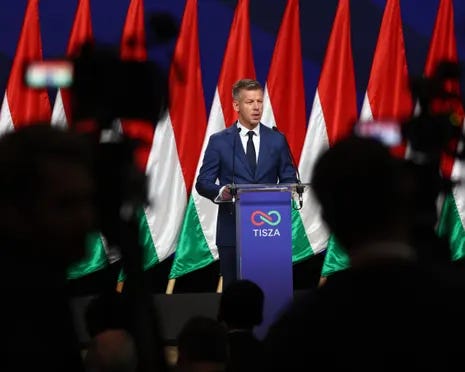
Barely elected, Péter Magyar wasted no time signaling he would drop Hungary’s veto on the EU’s €90 billion aid package to Ukraine — long blocked by Viktor Orbán. A pragmatist at home, the incoming Hungarian prime minister was equally clear on the financial arithmetic: like Slovakia and Poland, Hungary won’t be putting a single forint into the common pot for Kyiv.
So, who’s gonna foot the bill?
France, whose public finances are in their customary state of dire strait, will of course throw money into that pot — specifically, moneys take into the pockets of French taxpayers, who were never consulted and never consented - and can’t stand it anymore.
Brussels, meanwhile, has been scrambling for months to keep the Ukrainian funding pipeline flowing, growing so desperate it floated the half-baked scheme of seizing frozen Russian assets — a plan that unraveled about as quickly as it was announced.
![[ Russian Assets ] A History of Sheer Madness](https://substackcdn.com/image/fetch/$s_!zex8!,w_140,h_140,c_fill,f_webp,q_auto:good,fl_progressive:steep,g_auto/https%3A%2F%2Fsubstack-post-media.s3.amazonaws.com%2Fpublic%2Fimages%2Fce139167-401a-463a-9b36-375dc0fc4d71_784x775.png)
With the €90 billion veto lifted, Magyar has trained his sights on the next target: unlocking €17 billion in frozen EU funds, held back pending a checklist of reforms — anti-corruption measures, public procurement overhauls, accession to the European Public Prosecutor’s Office, academic freedom, minority rights including LGBTQ+ protections, and judicial independence.
Judicial independence. Does that ring any bells?
The judicial independence Brussels is demanding — and its corollary, dismantling a court system methodically packed with Orbán loyalists — will be no easy feat to deliver. And that’s the bitter irony: even armed with a parliamentary supermajority of more than two-thirds of seats, Magyar faces a judiciary that wasn’t built to be reformed from the outside. It was built to resist exactly that.

This “judicial independence” is not a new demand. Brussels already put a price on it in 2022 — trading the release of frozen funds for Orbán’s pledge that Hungary would clean up its judiciary.
He took the deal. He didn’t deliver.
In December 2023, Brussels declared itself satisfied — everything was in order, all boxes ticked — and released the €10.2 billion in frozen funds. To many observers, the Commission hadn’t so much assessed Hungary’s reforms as waved them through. Civil society organizations issued damning reports: the measures were cosmetic, poorly implemented, and riddled with gaping loopholes.
The most glaring? A provision allowing the president of the Kúria — Hungary’s Supreme Court — to remain in post indefinitely. Not a minor detail. In Hungary, the head of the highest court is widely seen as the transmission belt between executive and judicial power when he owes his appointment to the government. Which was precisely the case when Orbán installed András Zs. Varga in 2021.
Here is where the sleight of hand becomes worth examining closely. The 2023 reform technically banned the re-election of the Supreme Court president — previously achievable with a two-thirds parliamentary majority. But it quietly preserved an older rule: the incumbent stays on until a successor is elected, requiring that same two-thirds majority, while being exempt from the mandatory retirement age applied to other judges. The result: one third of parliament can permanently block any successor. What is formally forbidden on paper can be indefinitely permitted through parliamentary paralysis.
And Brussels saw nothing wrong with this.
This matters, because it sits at the very heart of a legal challenge to the 2023 fund release itself. On February 12th, the Advocate General of the Court of Justice of the EU — whose opinions the Court typically follows — called for the unfreezing to be annulled. The Commission, she found, had authorized the disbursement before Hungary’s judicial reforms had even entered into force, let alone been applied. She further faulted Brussels for failing to properly assess the actual independence of the Supreme Court and the Constitutional Court, and for offering no adequate justification for abandoning the conditions it had itself set in 2022.
But the picture isn’t complete without the timeline. At the very moment the Commission was deploying its conditionality toolkit against Hungary, it was also running headlong into Budapest’s veto on Ukraine aid — which required unanimity. The €10.2 billion unfreeze in December 2023 conveniently preceded Hungary’s withdrawal of its veto on a €50 billion Ukraine assistance package. The Commission has always officially denied any explicit deal. Orbán’s political director did not bother denying it at all.
Two years on, the situation is essentially unchanged. Judicial independence in Hungary remains unproven — but has been blessed by Brussels, at the European taxpayer’s expense and without their input, pending the Court’s ruling. Now the same judicial independence is once again the currency of negotiation, this time folded into the €17 billion package — with assurances, we’re told, that scrutiny will be tighter this time. Meanwhile, the €90 billion Ukraine aid package sits on the table, following the €50 billion of 2024, now that Budapest has lifted its veto.
The pattern, in fact, has a name. Roy Koranyi’s research on the limits of EU financial sanctions in rule-of-law enforcement documents precisely this dynamic: how the overlap of economic and political costs shapes what he calls Hungary’s strategy of selective compliance — performing just enough reform to unlock funds, while preserving the architecture of control underneath. Brussels keeps accepting the performance. The taxpayer keeps footing the bill.
The more things change…