

The Scope of the EU's Democratic Shield is expanding. Europol called upon to oversee "information manipulation."
The EP committee’s final report calls for expanding Europol’s mandate to cover hybrid threats and establishing a permanent monitoring group for elections across EU member states.


Online content surveillance, electoral process monitoring — Europe’s control architecture is accelerating its rollout ahead of 2027 and elections that could prove pivotal for countries like France and Germany, as well as for the future trajectory of the EU itself. But between what some are hoping for and what is actually achievable, the road ahead remains strewn with obstacles.
Consider the fate of the CSAM (Child Sexual Abuse Material) regulation, better known as ChatControl. After yet another extension of the temporary version of that text was rejected by the European Parliament, its President Roberta Metsola took it upon herself on 18 June to resuscitate it — which, incidentally, amounts to a blatant circumvention of the democratic process.
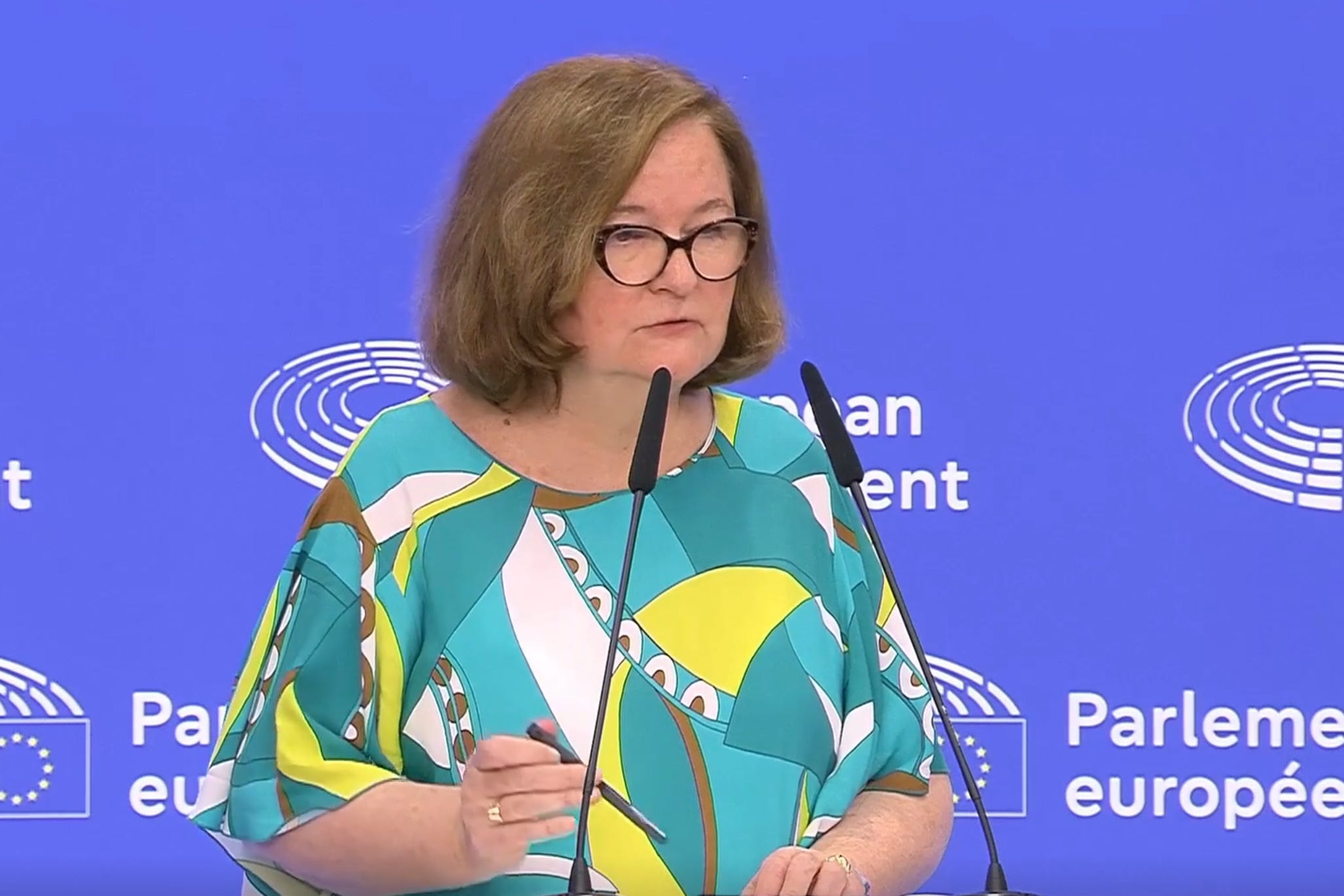
Consider also, as Czech journalist Cecílie Jílková explains in the article reproduced below with her kind permission, how the European Parliament established a special committee on the European Democracy Shield, chaired by French MEP Nathalie Loiseau (Renew Europe). The committee is calling for an expansion of Europol’s mandate to cover “hybrid threats” and “information manipulation”, as well as permanent monitoring of electoral processes across all member states. Until now, no EU body has exercised continuous oversight over elections held by member states. It is contrary to the Treaties.
All elections in the EU are nevertheless observed. That’s the prerogative of the Organization for Security and Cooperation in Europe (OSCE).
Time will tell whether the initiative succeeds — but its path is considerably more tortuous than a simple resolution pushed through by a temporary committee. First, because Europol currently lacks both the technical capacity and the legal basis for a mission involving monitoring online content and determining what qualifies as “information manipulation”. And because expanding its mandate touches a raw nerve with member states, as has already been seen on other issues such as the fight against migrant smuggling and trafficking.
Second, because this special committee is nothing more than a parliamentary body tasked with issuing recommendations — it holds neither regulatory nor legal powers. It falls to the European Commission — which holds legislative initiative — to table a legislative text along these lines. To our knowledge, no such text has been tabled, nor is one currently scheduled. Any text that is eventually produced would then need to be adopted by both the European Parliament and the Council.
One thing is clear: for all the time, money, resources, and political capital invested in controlling online content, the results have been remarkably weak. It is therefore worth asking what is really driving this process - and whose interests it ultimately serves.
Is Mrs. Loiseau pushing her own agenda - one that is franco-French rather than European, aimed squarely at France’s next presidential election? It seems the centrists are attempting another coup, this time using European institutions, since the French judiciary and elite civil service don’t appear ready to intervene as they did in 2017 when they took down front-runner François Fillon.
By Cecilie Jilkova - originally published in Czech at Reportéři on-line
The European Parliament’s Special Committee on the European Democracy Shield on June 23, 2026, approved and published its final report, which calls for the creation of a European Centre for Democratic Resilience. The Centre is to assume unified control over previously separate tools for monitoring online content, and a permanent monitoring group for electoral processes across all member states is to be established under its umbrella.
The committee also wants to expand Europol’s mandate to cover “hybrid threats” and “information manipulation.” The report was backed by a coalition of EPP, Socialists, Renew, Greens, and the Left. ECR, Patriots, and ESN voted against. The plenary vote of the full Parliament is scheduled for September.
What is the European Democracy Shield
In April, the European Commission launched its “Protect What Matters” campaign promoting the European Democracy Shield. The project combines three regulatory instruments: the Digital Services Act (DSA), the European Media Freedom Act (EMFA), and the Rapid Response System.
The DSA establishes so-called “crisis protocols” that allow the European Commission to bypass standard regulatory procedures and order platforms to take immediate measures, including suppressing the virality of content. EMFA enables algorithmic preference for media outlets that meet “recognized ethical standards.”
The Rapid Response System is a communication tool connecting fact-checkers and platforms for controlling the information flow during election campaigns.
Europol as a “data black hole swallowing fundamental rights”
The Democracy Shield committee’s report supports expanding Europol’s mandate — currently focused primarily on drugs, terrorism, and cybercrime — to include “hybrid threats” and “information manipulation.”
This is the third Europol reform in six years. The Commission proposes doubling Europol’s budget to 3 billion euros, introducing automatic and systematic uploads of data from national police databases, and creating a shared police data space on Europol’s cloud infrastructure.
Following this reform — the legislative proposal for which the Commission is preparing this year — Europol could also collect and analyze data about social media posts.
The Protect Not Surveil coalition of human rights organizations condemned the reform. According to Chloé Berthélémy of European Digital Rights (EDRi), the new mandate grants the agency “all its wildest wishes and continues its transformation into a data black hole — swallowing our fundamental rights and undermining justice, safety, and accountability.”
Europol has a history of collecting data illegally. In January 2022, the European Data Protection Supervisor ordered it to delete data on individuals with no established link to criminal activity. Instead of complying, the Commission retroactively legalized this conduct through a June 2022 regulation revision.
The Centre for Democratic Resilience restructures the existing system
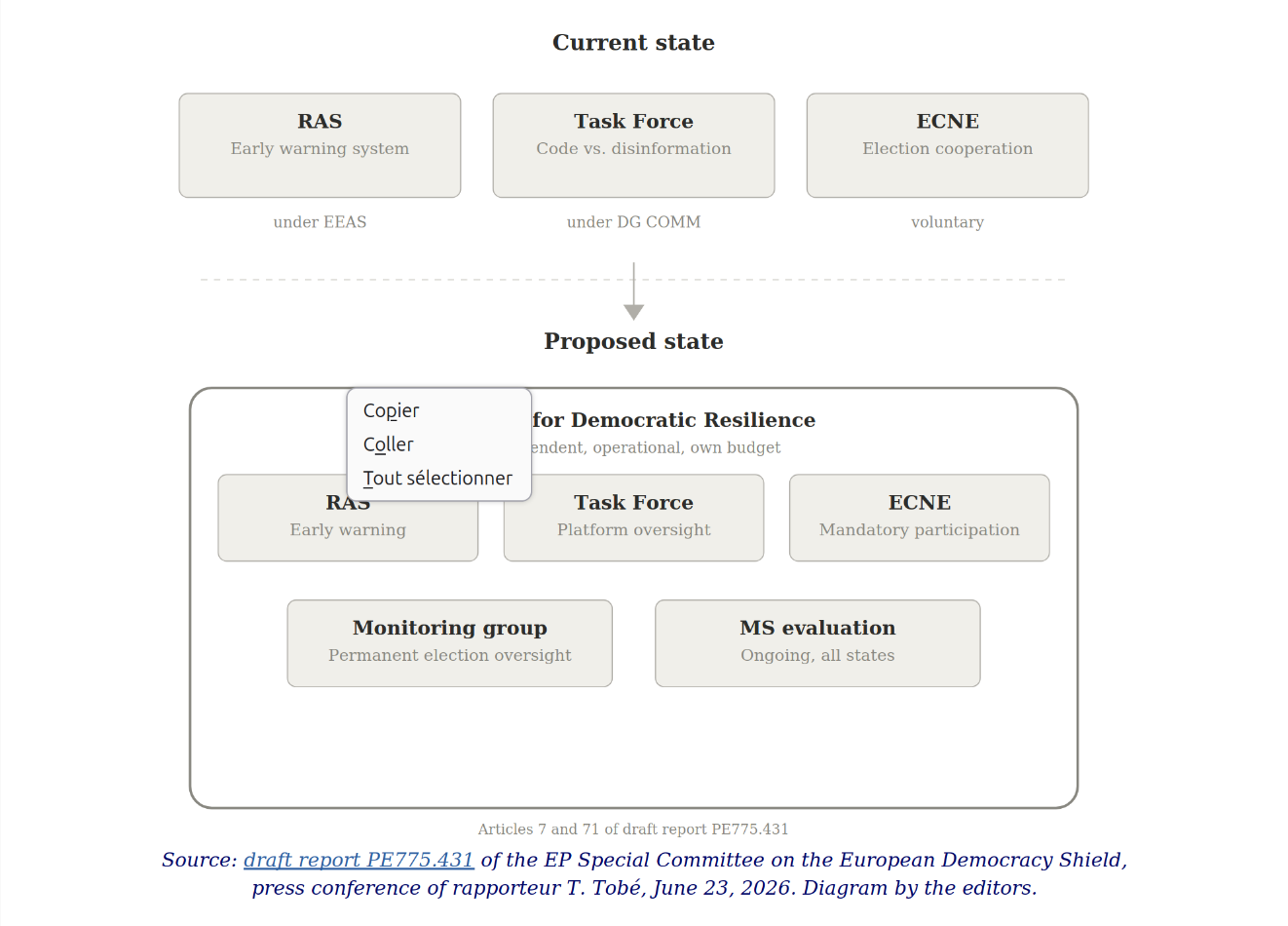
The committee’s report also proposes merging the currently separate tools for combating “Foreign Information Manipulation and Interference” (FIMI) under the unified management of the Centre for Democratic Resilience. Rapporteur Tomas Tobé (EPP, Sweden) said at a press conference on June 23 that the Centre should assume responsibility for operating the Rapid Response System, the Rapid Alert System (RAS), and the Task Force against disinformation.
The Rapid Alert System is an intelligence-sharing mechanism managed by the EU’s diplomatic service (EEAS). Established in 2019 under the Action Plan against Disinformation, it operates continuously, with activity intensifying around elections.
Its function is to gather intelligence on FIMI campaigns and share it among EU institutions and member states.
The Task Force against Disinformation (Permanent Task Force of the Code of Practice on Disinformation) is a standing body previously managed by the European Commission’s communications department (DG COMM). Created in 2022 as amechanism for overseeing signatories of the Code of Practice on Disinformation —i.e., platforms (Meta, Google, TikTok, X, Microsoft) and other signatories (fact-checkers, EDMO hubs, NGOs).
Article 71 of the committee’s report also requires all member states to participate in governing the Centre and introduces “ongoing evaluation” of their work on electoral processes. The previous model included no evaluation of member states.
Article 71 simultaneously establishes a permanent monitoring group to oversee elections. The wording does not distinguish between types of elections — it covers parliamentary, regional, and municipal ones. Prior to this, no EU body continuously monitored member state elections.
The European Cooperation Network on Elections (ECNE) previously functioned as a platform for voluntary exchange of experience among member states — no state was required to participate and none was evaluated. The committee’s report proposes incorporating ECNE into the Centre for Democratic Resilience and introducing two new elements: a permanent monitoring group that will continuously oversee electoral processes in all member states, and ongoing evaluation of how individual states implement the Commission’s recommendations on “inclusive and resilient electoral processes.” Participation is to be mandatory.
Impact on free speech and NATO
Through the combination of existing and newly proposed controls and regulations, the Union — according to both the report’s text and MEPs’ statements at the press conference — is defending itself against external enemies. However, domestic Euroskeptic, conservative, and right-wing voices may also be affected, including those from the United States.
The report states that “certain forms of manipulative information activities may also arise from actors operating within the EU.” Committee Chair Loiseau criticized MEPs who voted against the report at the press conference for “rejecting the points about attacks coming from within the EU.”
The report also addresses the U.S. stance. Rapporteur Tobé described American and Chinese companies as part of a “dangerous cocktail” in which “powerful digital platforms, mainly based in the U.S. and China, fail to take sufficient responsibility.”
The sanctions through which the EU intends to enforce its regulations target these platforms.
Vice President JD Vance suggested during the 2024 campaign that the United States might leave NATO if the EU does not abandon its regulation of American platforms and censorship of American citizens.
“If NATO wants us to continue supporting them and NATO wants us to continue to be a good participant in this military alliance, why don’t you respect American values and respect free speech?” Vance said in an interview with podcaster Shawn Ryan.
In February 2025, the U.S. House Judiciary Committee, chaired by Republican Jim Jordan, issued subpoenas to eight American technology companies to determine the specific impact of EU DSA legislation on American users. Documents obtained from the platforms confirmed that they had censored Americans’ free speech under pressure from this regulation.
For example, during a non-public workshop in May 2025, the European Commission classified the phrase “we need to take back our country” as “illegal hate speech” to be censored by all platforms. This phrase has been used across the political spectrum by American politicians, including former Vice President Kamala Harris, Senator Elizabeth Warren, and President Donald Trump. The workshop was documented by the Judiciary Committee.
A 2024 study analyzing content removed by platforms in Germany, France, and Sweden found that 87 to 99 percent of deleted content constituted legally permissible speech. According to the study, platforms prefer to over-moderate rather than risk fines of up to six percent of global revenue under the DSA.
 | Un article invité par
|