

The Source of Jeffrey Epstein's wealth
Epstein's fortune? Four decades of relentless financial criminality and shadowy offshore maneuvers, all propped up by exemptions from core U.S. financial market regulations dating from the 1980's.

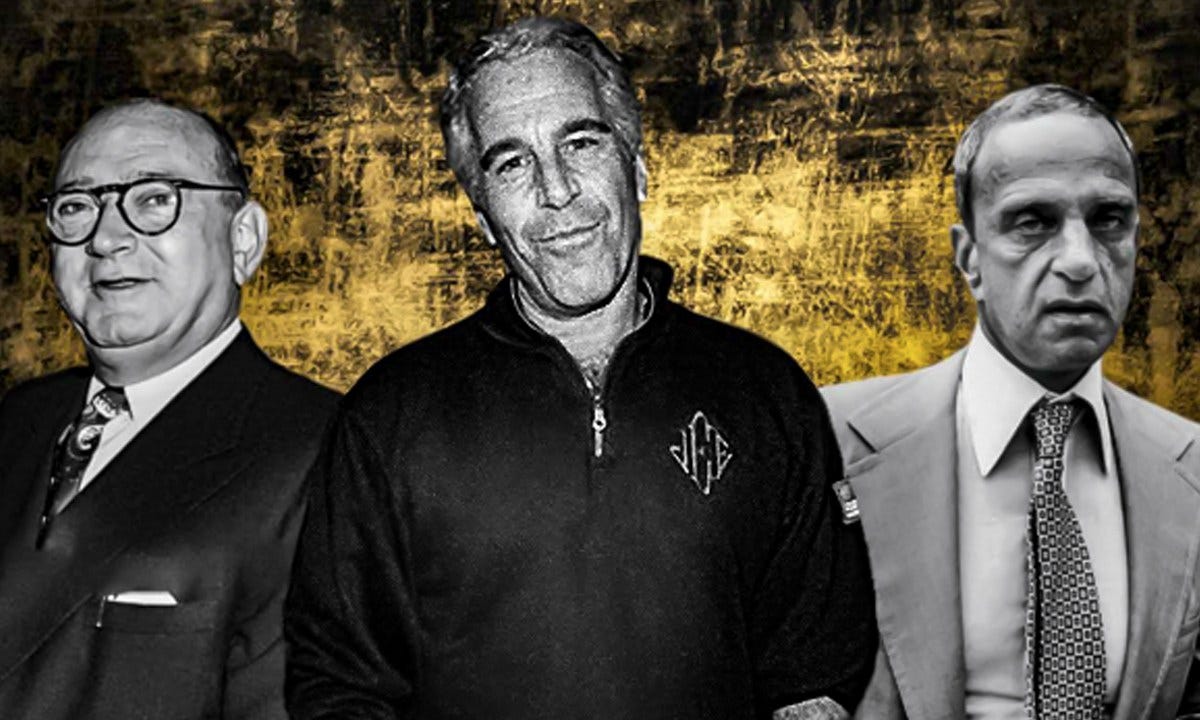
The core of the Epstein operation—far beyond mere finance—emerges clearly in Whitney Webb’s exhaustive work since 2019, resulting in One Nation Under Blackmail. In two meticulously sourced volumes, Webb traces the fusion of intelligence agencies, organized crime syndicates, and sexual blackmail networks dating back to World War II.
Epstein’s empire wasn’t an aberration; it was a modern iteration of long-standing tactics where state actors and criminal elements collude for leverage, protection, and control. Webb’s research, initially dismissed or smeared by mainstream outlets as fringe, has since been quietly mined and repackaged by the very journalists who once ridiculed it. This is not journalism; it is parasitic echo-chamberry—reheating others’ investigative labor once the story becomes safely profitable.
The origins of Jeffrey Epstein’s fortune are not some impenetrable mystery—they are documented, yet deliberately obscured by layers of media complicity and institutional inertia.
Recruited in 1976 by Alan “Ace” Greenberg, the CEO of Bear Stearns, one of Wall Street’s most notoriously aggressive and rule-bending firms, Epstein rocketed from a college dropout and former Dalton School teacher to limited partner in under five years. Greenberg, who prized “poor, smart, and desperate to get rich” hires over pedigreed Ivy Leaguers, handed Epstein a golden ticket into options trading and “special products.”
Amidst red flags—including résumé lies, questionable personal loans, and an SEC probe into potential insider trading—Epstein was suspended, fined, and left in 1981 under a cloud.
Yet the ties never truly severed.
Epstein remained a Bear Stearns client until its 2008 collapse and fire sale to JPMorgan Chase. Even after his 2008 Florida plea deal, major banks like JPMorgan and Deutsche Bank processed billions in his transactions, often overriding compliance warnings. This wasn’t casual banking; it was sustained, lucrative facilitation that spanned decades and survived his conviction.
French “investigative” reporters jumping on the latest DOJ document dumps exemplify the syndrome. The recent releases—over 3 million pages under the Epstein Files Transparency Act in early 2026—contain photos, emails, transaction records, and more, yet they will spark no new prosecutions. DOJ officials have explicitly stated there is no “client list,” no credible blackmail evidence warranting charges against third parties, and nothing to predicate fresh investigations.
Victims’ identities have been mishandled in redactions, prompting takedowns, but the powerful walk free. This is not revelation; it is controlled disclosure theater—enough to titillate, too little to threaten the system.
Forget the sensationalism. Epstein’s world was run by aging boomers now in their 70s and 80s; the machinery has already evolved. Cryptocurrencies—misbranded as decentralized liberation—are in reality programmable, traceable assets ripe for the same elite capture and shadow financing that Epstein mastered through offshore vehicles and lax regulation.
The international finance nexus is ancient: François I of France leaned on Italian bankers; the Rothschilds bankrolled Napoleonic wars and beyond; post-WWI creditors propped up Mussolini to enforce Italian debt repayment; the same financial interests greased Hitler’s rise for Germany’s economic stabilization after over a decade of hyperinflation and political strife akin to civil war.
French historian Annie Lacroix-Riz has documented this with surgical detail, particularly the economic collaboration under Vichy and the Occupation—where French elites and banks aligned with Nazi occupiers to preserve capital.
"La grande finance américaine et française a financé le réarmement allemand à partir de 1921"

Marc Bloch, l’historien auteur de L’étrange défaite, résistant torturé et exécuté par la Gestapo le 16 juin 1944, écrivait en avril de la même année :
Epstein fits seamlessly into this lineage: a financier whose wealth derived not from genius but from protected access, intelligence-adjacent networks, and the perennial blind eye turned toward elite predation. The “discovery” of his criminality is laughable. What we witness is not awakening, but the system’s periodic safety valve—releasing just enough to vent pressure without dismantling the machine. The real scandal is not what was hidden; it’s how brazenly it was tolerated, and how swiftly the next iteration adapts.
When governments forfeit financial sovereignty, they become puppets of their creditors—enslaved to private agendas that eclipse national priorities. Debt isn’t just borrowing; it’s a Faustian bargain, collateralized against future public wealth that states can plunder at will through taxation. This breeds shadowy cabals: a tight-knit elite of bureaucrats and bankers, operating in a lawless void beyond oversight, accountability, or justice.
Creditors’ sole mantra? Repayment with interest. Thus, they rig the game—handpicking pliable leaders to ensure perpetual servitude.
These hidden empires spawn exclusive looting machines, accessible only to insiders. Think of France’s ancien régime’s fermiers généraux: rapacious private tax farmers having leased to the the king the power to levy taxes, gorging themselves tenfold on the backs of the peasantry. This was engineered predation.
That very rot ignited the French Revolution—not with the Bastille’s theatrical storming in Paris, but earlier, in June 1788, amid Grenoble’s gritty unrest. There, nobility, clergy, and third estate defied royal exile of the Dauphiné Parliament, which had balked at registering edicts for a desperate tax overhaul to bail out a bankrupt monarchy.
Sound familiar? The parallels to today’s French fiscal deadend aren’t coincidental. No wonder France’s ruling clique—after half a century of plundering the nation while indulging in excess—quivers in fear.
Social media crackdowns? Spare us the free-speech facade. The real target isn’t “hate speech”; it’s quashing platforms that empower mass mobilization, as proven by the Arab Spring uprisings and the 2018 Yellow Vests’ protests. Recall Thierry Breton, the EU’s digital enforcer in 2023, brazenly vowing to purge any content “inciting revolt”? Preemptive suppression of dissent.
Sure, free expression underpins democracy. But we conveniently ignore a far thornier pillar: voluntary consent to taxation. It strikes at the state’s core legitimacy—and its survival.
In our era, sovereign debt isn’t crowdfunded by citizens anymore; it’s hawked by investment banks on global markets. EU rules bar direct appeals to public savings, funneling everything through the financial markets’ casino.
Government bonds? They’re the bedrock of modern finance in our fiat-fueled, floating-rate economy. No gold or silver anchors? A state’s IOU is the ultimate “safe” bet.
Textbook economics peddles the myth: markets align supply and demand for peak efficiency and wealth creation. Fine print? That’s for suckers who follow the rules. True fortunes demand cheating the system—sidestepping transparency for insider edges.
Glenn Loury’s razor-sharp dissection in his 2024 Substack essay, “Jeffrey Epstein as Middleman: An Economic Analysis”, hits bulleye.

Far from an outlier, Epstein exemplifies how elite brokers amass wealth by exploiting “relational intermediation”—a fancy term for weaponizing connections in the shadows of power.
Loury dismantles the mechanics: Epstein wasn’t a standard financier peddling stocks or bonds; he was a human switchboard, bridging “structural holes” in elite networks across finance, philanthropy, academia, politics, and sordid private spheres. His “product”? Access—curated introductions, hosted galas, vague facilitations that reduced “search frictions” for the powerful, all while extracting tolls through accumulated favors and obligations.
Loury’s verdict? Epstein’s fortune stemmed from mastering asynchronous, trust-based exchanges outside market norms—blurring facilitation into corruption, predation into prestige. This isn’t aberration; it’s the blueprint for how global power really flows: not through efficient markets, but via unaccountable middlemen who rig the game for the few, at the expense of the many. Wake up: the Epsteins of the world aren’t anomalies; they’re the system’s inevitable offspring.
