


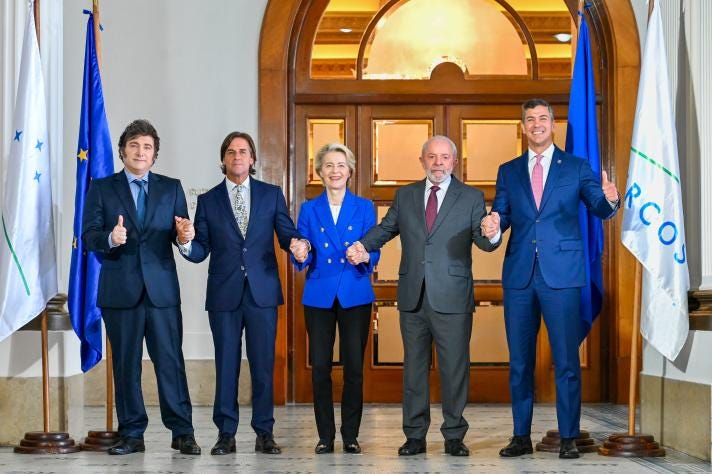
What does the EU–Mercosur agreement tell us, now that it has cleared a decisive hurdle on its way to adoption, with the EU Council authorising its signature on 9 January by a narrow qualified majority? That it is good—for trade? Bad—for the climate and biodiversity? Lopsided—tilted neatly in Germany’s favour?
Look at it through the narrow, unmistakably French lens, and one conclusion stands out: the agreement seals the reality that France, personified by Emmanuel Macron, no longer carries much weight internationally—and barely any more within Europe itself.
It is hard to miss how, in Brussels and Strasbourg, every procedural trick was deployed to neutralise the French veto threat and ram the deal through. National parliaments were sidestepped—starting with the French one, which had made its opposition clear. The European Parliament, too, has been temporarily bypassed: its vote, scheduled only after the agreement is signed, currently prevents the effective implementation of its two pillars. For now
L’Éclaireur reporter it plainly on 9 January
![[ Accord UE-Mercosur ] "On vous prend pour des jambons"](https://substackcdn.com/image/fetch/$s_!qipF!,w_140,h_140,c_fill,f_webp,q_auto:good,fl_progressive:steep,g_auto/https%3A%2F%2Fsubstack-post-media.s3.amazonaws.com%2Fpublic%2Fimages%2F8eedbe3f-476d-452d-8f65-0c7706c9141b_1810x1172.heic)
It is just as hard to ignore that, in France, the issue had morphed into a matter of explosive domestic politics rather than a genuinely agricultural or economic debate. In other words, the dice were heavily loaded from the start.
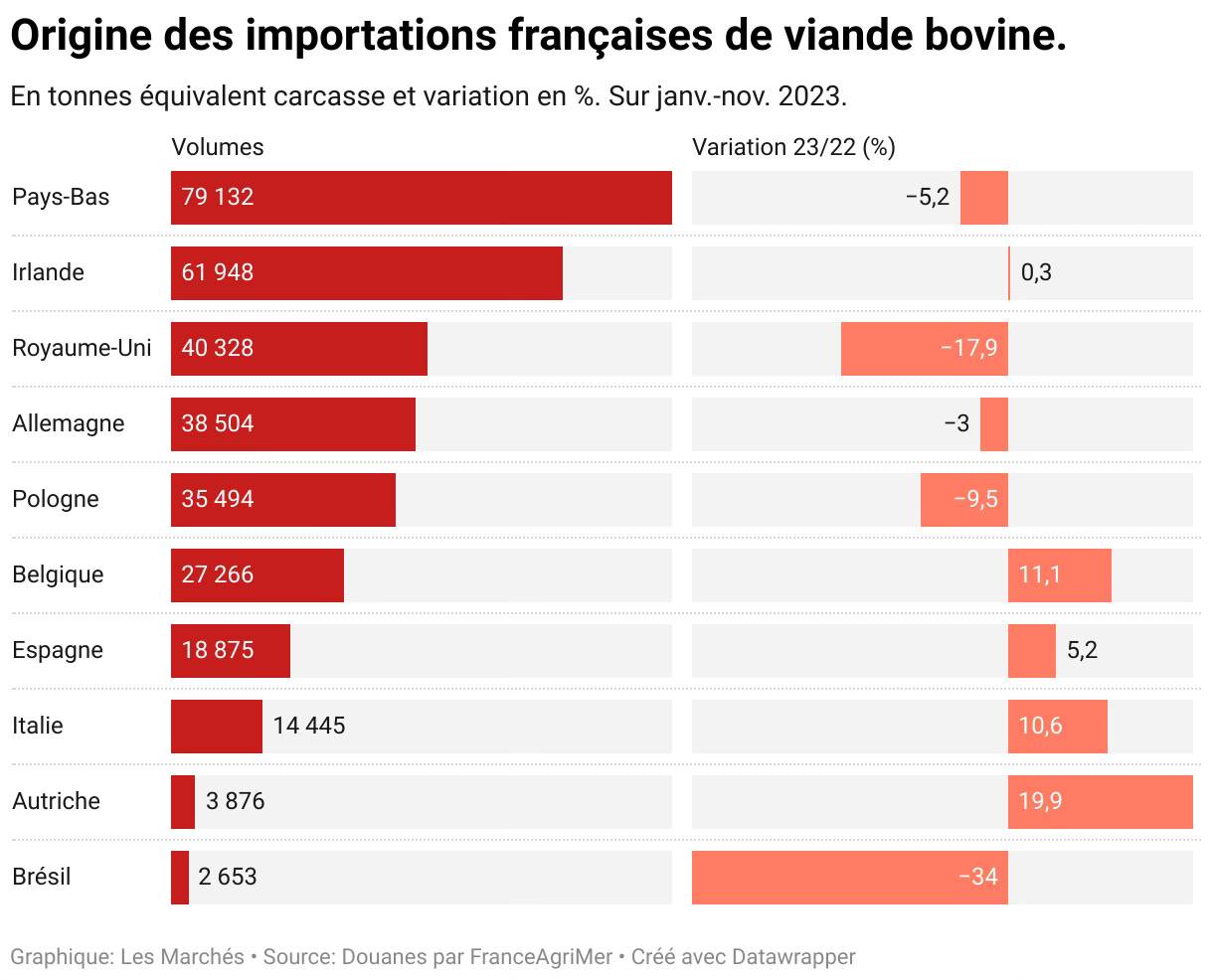
Loaded, first of all, because if French agriculture is going under, it has largely only itself to blame. Or rather, not Brazil, not Argentina—but the French government. It bears repeating, loudly and often: even if South American farming is highly competitive and France is drowning in regulatory constraints, Argentina and Brazil are not its main suppliers of beef.
The leading supplier is the Netherlands, thanks to repacking of imported meat thus accounted for as Ducth. The second is not a Mercosur country either, but Ireland. The third is the UK. The fourth, Germany.
Brazil comes in only tenth.
“There is indeed a major crisis in France’s beef cattle sector: a steady decline in domestic production, a trade deficit in volume, and chronically low incomes for farms specialising in cattle. But the real problem is not some hypothetical loss of competitiveness to Brazil or Argentina. It is France’s loss of ground to its European neighbours.
The French beef industry is being outcompeted within Europe itself. Blaming South America is a convenient distraction—one that spares policymakers from confronting the far less comfortable truth at home.”, underscored in February 2024 in La Tribune by economist Pierre Buigues, who spent twenty years working at the European Commission.
Here is a tight, biting English editorial rewrite, faithful to the facts but sharpened in tone:
The same holds true for sheep farming. In 2021, France imported 79,300 tonnes (carcass equivalent) and exported just 9,700. Its main suppliers are not Brazil or Argentina, but the United Kingdom and Ireland, New Zealand, and Spain. And we are not even getting into Ukrainian chicken.
Rice? France’s leading suppliers are Italy, Cambodia, Thailand, and Pakistan. Honey? Mostly imported from Ukraine, Spain, Germany, and China. In reality, only soybeans come predominantly from South America—chiefly Brazil.
Do Mercosur countries threaten the European Union’s so-called “food sovereignty”—a concept that exists more as a slogan than a legal reality? No. Is France far more exposed to competition from its European neighbours? Absolutely.
Once Europe’s leading agricultural power, France no longer carries the same weight. While it remains the EU’s top producer of beef, cereals, and wine, its trade balance is tilting dangerously. In 2015, the agri-food surplus stood at over €8 billion. By 2024, it had shrunk to €3.5 billion, before collapsing to just €350 million over the first eight months of 2025—a level unseen since the late 1970s, at a time when both European and global demand are rising.
The EU–Mercosur agreement—and the political sidelining of France, above all of its representatives—should also be read for what it is: a stark warning flare, illuminating France’s ongoing economic downgrading. We are not quite at the bottom yet.