



The scale of the cleanup required within French institutions is nothing short of staggering. Nowhere is this more evident than in the first-instance ruling in the “Jean-Michel Trogneux” cyberbullying case, where trial judges appear to have bowed to intense political and media pressure, delivering what many view as a legally aberrant decision that flies in the face of 150 years of established jurisprudence.
The Paris court’s January 5, 2026, ruling, which handed down prison sentences and fines to ten individuals for spreading rumors about Brigitte Macron’s gender, has been widely framed as a prelude to a battle turned transatlantic. Media outlets from Reuters to the BBC (what a surprise!) have highlighted its potential to embolden the Macrons, portraying the French verdict as a moral and evidentiary boost in their pursuit of Candace Owens, who has amplified similar theories on her podcast and social media, even staking her “entire professional reputation” on the claim that France’s First Lady was born male.
Former French Prime Minister Gabriel Attal—never one to miss an opportunity for ill-considered commentary—has rushed to applaud the verdict, as has the bulk of France’s political class. This speaks volumes about the abysmal standards of those who presume to govern France: for them, a law is valid only insofar as it serves their personal interests first.
One might gently remind Gabriel “Tchoupi” Attal that justice is not served until appeals and any potential review by the Cour de Cassation have run their course. Moreover, this case has never been about prosecutions for mere insults or defamation, but rather for cyberbullying—a distinction that seems lost on those celebrating premature victory. Attal pursued limited legal studies and never truly mastered the subject.

This episode underscores a deeper malaise: when the judiciary metes out prison terms for relaying online “rumors”, however offensive, it risks inverting priorities. Protecting the powerful from ridicule should not trump the principles of free expression enshrined since the Third Republic and the 1881 Free Press Law.
The legal foundation for the prosecutions and the recent first-instance verdict in the “Jean-Michel Trogneux” affair rests on the controversial 2018 law championed by former minister and self-help book author Marlène Schiappa, which introduced a new offense into the French Criminal Code—Article 222-33-2-2—specifically targeting online harassment, including group or “pack” cyberbullying.
This provision, created largely from scratch, expanded the definition of moral harassment to encompass repeated or collective actions via digital means that degrade a person’s living conditions and impair their physical or mental health. While presented as a safeguard for society and its most vulnerable members, it encroaches on free expression by criminalizing scattered online commentary, even when uncoordinated.
As highlighted in the “Twitter Files France” investigation by Thomas Fazi and the author of this piece, this legislative evolution forms part of a broader, deleterious legislative process akin to censorship. Far from broadly protecting the weak, it appears tailored to shield a narrow elite obsessed with image management, intolerant of criticism or mockery.
To compound matters, Macron established a specialized national prosecutor’s office against online hate—the Pôle national de lutte contre la haine en ligne—in 2021, ostensibly because such cases are inherently complex. This rationale rings hollow: investigations into online speech typically involve technical tracing by specialized investigators to attribute statements to individuals or groups. Any freshly minted magistrate from the École nationale de la magistrature could competently oversee them.
In any republic founded on robust debate and irreverence toward authority, deploying such machinery against alleged rumor-mongering—however distasteful—raises legitimate questions about proportionality and intent. True protection of dignity need not come at the expense of open discourse.
At the heart of the recent convictions in the cyberbullying case targeting France’s “First Lady” lies a strategic legal choice: Brigitte Macron could not plausibly sue for defamation over claims that she was born male. Had she done so, the case would likely have been dismissed amid widespread public ridicule.
Under French law, gender transition is fully legal, thus alleging that someone is transgender does not constitute defamation. As established in prior rulings—including a 2025 Court of Appeal decision acquitting two women in a related matter—imputing a gender transition or identity discrepancy to an individual does not impair their honor or reputation in a manner actionable as defamation. Such claims, however false or offensive, fall short of the legal threshold for attacking one’s dignity.
Brigitte Macron and prosecutors thus pivoted to moral harassment via digital means. This offense requires proof of repeated or collective actions causing a genuine degradation of living conditions, manifesting in physical or mental harm. Brigitte Macron did not appear in court or submit to a mandatory psychological evaluation to substantiate moral prejudice. Instead, her daughter, Tiphaine Auzière, testified to the family’s distress and the rumor’s impact on daily life. No material prejudice could be claimed, as the unofficial role of “First Lady” carries no salary—expenses are drawn from the presidential budget, precluding any argument of financial loss.
Established jurisprudence, both French and from the European Court of Human Rights, affords public figures lesser protection against libel and slander than private citizens. By cultivating a highly visible media presence, staging public appearances alongside her husband, and assuming a non-existent institutional role as First Lady—without any constitutional and legal standing—Brigitte Macron has invited broader scrutiny. The law expects such figures to tolerate heightened ridicule or satire, far more than a private individual might.
This case’s true crux revolves around the couple’s age difference: a teacher-student relationship initiated when the future president was allegedly under 15. Resorting to harassment charges sidesteps these uncomfortable realities, shielding public figures from the robust debate the public demands.
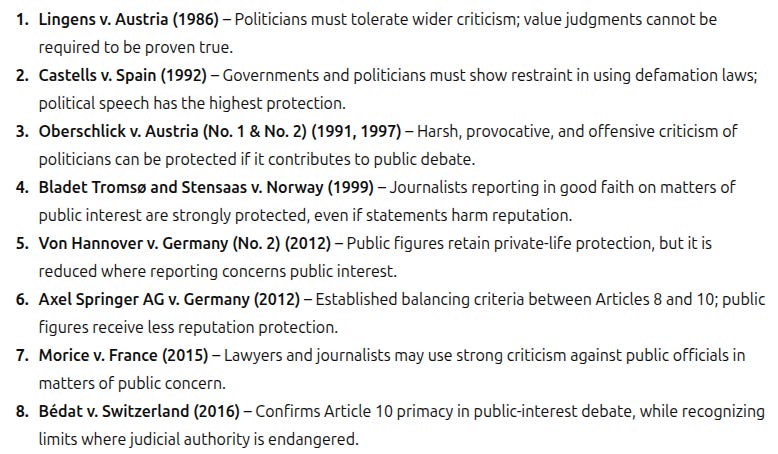
The following summary table highlights key rulings by the European Court of Human Rights (ECtHR). These cases illustrate a recurring tension: French law provides and French courts often impose sanctions for criticism of public figures, defamation, or controversial speech that the ECtHR deems disproportionate, particularly when involving political debate, journalism, or satire.
What is truly frightening about this affair is what it reveals about those in power—figures as glossy and superficial as a Paris-Match1 cover, so utterly flat, in Nietzsche’s sense, that one cannot glimpse any depth beneath the veneer.
They crave power, fame, and wealth, yet are intimately convinced that these are their natural birthright, owed without counterpart, at no cost, and certainly without contestation. One is reminded, inevitably, of the degenerate French court nobility on the eve of 1789: a caste so detached from reality, so persuaded of its own inviolability, that it could not comprehend why the common people refused to bow in silence and eat brioche they could not afford instead of the bread they didn’t have.
Faced with persistent rumors that no court ruling can ever truly extinguish—and which, as experience shows, are only amplified by legal action—the only dignified and intelligent response is the one mastered decades ago by Salavator Dali’s lover2, model, singer, actress and TV host Amanda Lear.
For years dogged by the very same claim that she had been born male, she responded not with lawsuits but with wry, devastating humor, turning the gossip into an asset and emerging all the more enigmatic and untouchable.
As appeals will be filed against the first-instance convictions —recalling that Brigitte Macron was previously rebuffed on appeal in a related 2025 case—the burning question on observers’ minds is the ripple effect on the high-stakes defamation lawsuit the Macrons have filed against American conservative commentator Candace Owens in the United States.

The answer is indeed none—for several compelling reasons that expose the fundamental disconnect between the two proceedings.
First and foremost, American courts operate independently and show little deference to foreign judgments, particularly in defamation cases governed by the First Amendment’s stringent protections for speech. French jurisprudence, rooted in a legal tradition that prioritizes “public order”, holds no precedential or persuasive weight in US courts. The Paris first-instance ruling—convicting ten individuals under cyberbullying statutes rather than defamation—addresses an entirely different legal framework and cannot be imported to bolster claims of falsity or malice in Delaware.
Second, by pursuing Owens in the United States, the Macrons have elevated the matter into the diplomatic realm. US authorities and judiciary will scrutinize the French verdict closely, recognizing it as a prosecution for online harassment, not defamation. As prior appeals in related French cases have demonstrated (including Brigitte Macron’s setback in 2025), imputing transgender status is not inherently defamatory under French law precisely because gender transition is legal and protected.
Finally, American diplomacy has viewed this saga as a politically motivated PR operation by the Macrons to stifle dissent, rather than a genuine defamation action. Sources indicate that relevant channels may convey this perspective to the presiding judge, as permitted under rules allowing amicus-style input on foreign law or public policy implications. Far from strengthening the Macrons’ hand, the heavy-handed French convictions risk portraying their US suit as an extraterritorial overreach, alienating a U.S. judiciary protective of robust free speech.
Rather than quelling the controversy, these first-instance sentences—subject to appeal and likely reversal on proportionality grounds—will only intensify widespread public resentment toward the French presidential couple and the perceived weaponization of justice. A substantial segment of the population already views the affair as emblematic of elite detachment and intolerance for scrutiny. This pyrrhic “victory” achieves little beyond deepening national discord. True concorde nationale demands leaders who rise above ridicule, not those who mobilize the state to silence it.
France’s main “people” magazine
Dali used to tell her “tu es une belle tête de mort”, you are a beautifull dead skull.