


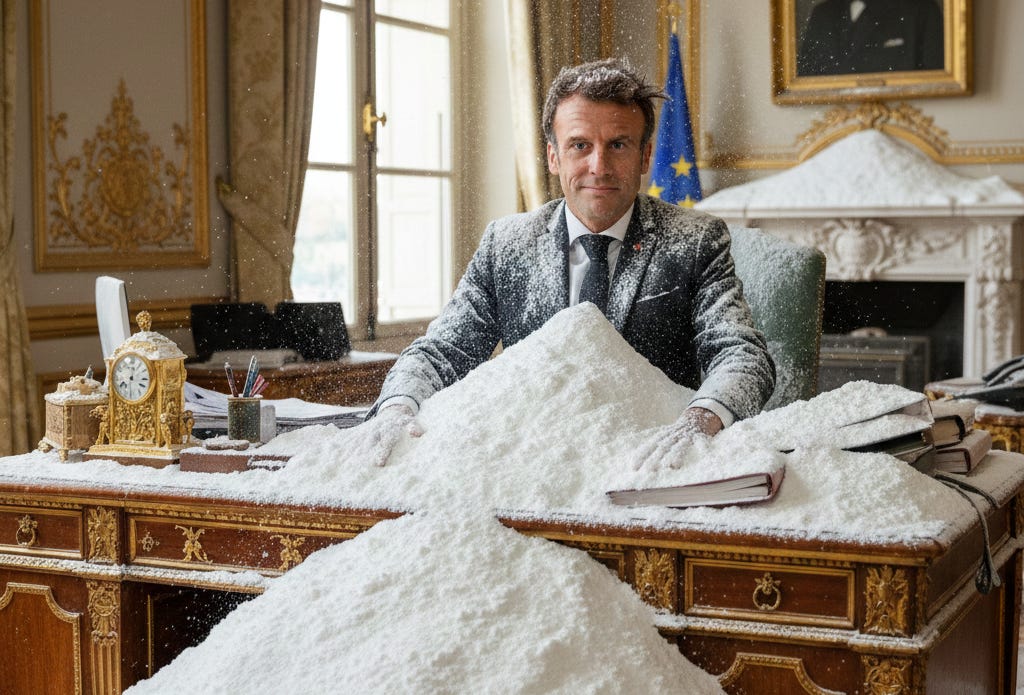
Here comes Emmanuel Macron for his umpteenth grandstanding trip to Marseille—sources tally at least a dozen since 2017, with this December 16, 2025, visit marking yet another ritual flex in the endless “war” on drug trafficking. Watch in awe as he unveils his masterstroke: recruiting “commissaires de justice” (the rebranded bailiffs) to chase down fines from drug users, jacking the penalty up to €500 a pop.
We’re told this targets the downtown bourgeois crowd—the ones who can actually afford to pay—who supposedly drive the cocaine market. Nice myth, but it’s ancient history. Cocaine prices have cratered to historic lows: around €45-50 per gram on average per the OFAST’s (the French DEA) 2025 report, thanks to a global production explosion flooding Europe with ultra-pure snow.
The powder isn’t just for the elite anymore; it’s democratized across all social classes, with over 1.1 million French adults admitting use in the past year alone—touching workers, students, professionals, everyone.
The narcotics flooding France are overwhelmingly imported—none of this homegrown in the Hexagone. Drying up demand? A pipe dream; it’s impossible. The issue is abundant and cheap supply.
The real scandal isn’t the users—it’s the glut of offer and the glaring political unwilligness in refusing to tackle money laundering head-on. Instead, we get vaudeville: bigger fines for the little guy, while the pipelines from Latin America via Morocco, the Netherlands, Belgium, Spain, Italy and the Balkans routes remain untouched for fear of “diplomatic fallout.”
Eight years into this administration, and the “effectiveness” is on full display: record seizures (70+ tons of coke in 2025), yet consumption skyrockets, violence festers, and the black market balloons to billions. Bravo—another triumphant photo op in Marseille, while the real “war” goes unwaged.
Restore border controls? Perish the thought! That would be an unforgivable sacrilege against the holy grail of the EU’s Single Market and the sacred freedom of movement for goods, capital, and people!
Somehow, it’s unthinkable to disrupt the very mechanisms that make the narcotics bazaar thrive: those wide-open EU internal frontiers - sorry, the internal market, where goods, capital and people freely flow.
Scan every heavy truck carrying cargo from Belgian, Dutch, Spanish, and Italian ports—and every lorry coming in from the Balkans? No.
Put more customs officers in the ports, more cops—gendarmes1, really, gendarmes are the ones who should be sent—into the “lost territories of the Republic” ? No.
Instead of imposing fines that are difficult and costly to collect, require drug addicts to undergo treatment? No.
Set the DGSE’s Action Division on the heels of the “kingpins,” most of them based in Dubai, North Africa, and elsewhere? No.
Do the same with the hubs of the money-laundering networks—that is to say, ultimately lawyers and banks? No.
Send the tax authorities to inspect every shady business across the length and breadth of France—kebab shops, late-night groceries, “barber shops,” and the like? No again.
The establishment lectures us that slapping genuine sanctions on any country deeply entangled in Europe’s drug supply chains—like visa curbs, cracking down on hawala-style transfers, vetting banks properly for money laundering, or publicly freezing the assets of well-connected kingpins—would be an unforgivable “diplomatic faux pas” that shreds any form of cooperation. Take Morocco, after all, a key partner in seizures and arrests, even as Moroccan-linked networks (the infamous Mocro Maffia) dominate cocaine routes into Europe and hashish production fuels billions in illicit trade.
Yet, somehow, it’s perfectly fine to launch a full-scale assault on the online privacy of every single French citizen, forcing the entire population to pay the price because a handful of criminals use encrypted messaging apps. This, from a French state that is spectacularly incompetent: it obsessively multiplies platforms and files on citizens for every conceivable (and inconceivable) reason, while simultaneously proving utterly incapable of securing any of it. Are you running GrapheneOS on your phone? You are drug trafficking pedophile terrorist.

Of course, when you hand out fat public contracts to consulting firms run by old palsto to manage the state’s IT systems, with the unpoken promise of cushy private-sector landings down the line, you’re practically begging for corruption. But heaven forbid we upset a drug-trafficking regime instead.
Touch that alliance? Perish the thought. But when it comes to eviscerating the digital privacy of law-abiding French citizen to chase a tiny fringe of encrypted-app-using crooks? No hesitation.
Suddenly, principles evaporate. Proposals to force backdoors into Signal and others—framed as anti-narco tools—nearly became law in 2025, only to be shot down amid outrage over the inevitable security holes they’d create for everyone. All this from a government that hoards citizen data in sprawling, poorly secured databases: witness the 2024 France Travail2 mega-breach exposing 43 million records, or the steady 20% annual spike in notified hacking incidents, proving the state’s own incompetence at basic cybersecurity.

And let’s not forget the cherry on top: billions funneled to consulting giants like McKinsey—firms run by insiders with revolving doors to power—amid scandals of tax dodging, inflated contracts, and undue influence. Those “fat public deals for pals” aren’t just inefficiency; they’re a systemic grift that breeds the very corruption the state claims to combat. Priorities, indeed: shield cronies, but surveil and inconvenience the masses. It’s not incompetence—it’s calculated cowardice.

Not only does the French political class utterly fail to grasp organized crime—or deliberately turn a blind eye because parts of it are their clientele—but they couldn’t care less. In fact, they quietly celebrate it: the drug trade keeps millions employed in the shadows (and yes, it’s conveniently baked into GDP calculations, adding a tidy €2.7–6 billion annually to France’s “wealth,” per official estimates since EU harmonization in 2014), propping up a twisted version of “civil peace” in neglected neighborhoods.
The DZ Mafia?3 Spare us the dramatic labels—no octopus-like syndicate, no secret society outfit like the italina OGs. It’s just a loose agglomeration of suburban thugs who were allowed to thrive, much like the Mocro Maffia in the Netherland before them. These unsophisticated wannabe Tony Montanas aren’t masterminds; they’re opportunistic punks playing Scarface.
And their money-laundering schemes? Pathetically predictable: cash funneled through opaque saraf and hawala networks, suitcases of bills smuggled across Europe’s wide open internal borders, gold bought in Italy, then shipped to Kosovo and Turkey—with the clean counterpart wired back to accounts in Dubai, Morocco or elsewhere.
Exactly as exposed in that major 2025 Italian bust: 55 kilos of gold bars and €2.5 million in cash seized from a network tied to the DZ Mafia, blanching tens of millions from Marseille’s narco-profits.
Yet the elites wring their hands over “diplomatic fallout” if we dared disrupt the real pipelines. The state pretends to fight crime while subsidizing its economic footprint and letting these franchises buy silence with groceries, kermesses, and handouts—purchasing the very “paix sociale” that masks surrender.
Money laundering thrives on the sleight-of-hand magic of compensation—think of it as the criminal world’s version of a zero-sum shell game. Here’s a crude but spot-on example: You sling €500,000 worth of dope on French streets, hand the filthy cash to a middleman in France, who slips you a code and dials up a counterpart in, say, Dubai, running an exchange bureau. “Cough up €450,000 to whoever flashes this code,” he says. Presto— you’ve got pristinely “licit” funds waiting in Dubai, while the intermediaries cook up fake invoices or other schemes to square their books on either end. No traces, no fuss, just a global daisy chain.
And wouldn’t you know it, a eerily similar racket played out right until 2012 under the nose of a “respectable” bank in France: HSBC. Picture this—a trio of Moroccan-Jewish brothers, the El-Malehs, orchestrating a billion-euro-plus symphony of drug money and tax fraud laundering for years, as exposed in the 2018 Paris trial that nailed them. Meyer El-Maleh, the Swiss-based fund manager, funneled the loot through his outfit. His brother Nessim, cozily embedded at HSBC Private Banking in Geneva (snapped up from the late Edmond Safra’s empire, that Sephardic banker infamous for his own massive laundering ops4), greased the wheels from the inside.
And Mardoché, the third bro? He was the Paris grunt, scooping up drug profits from dealers and doling them out in crisp cash to wealthy tax-dodging elites—mostly fellow Sephardim.
The dirty bills handed off in France? Pulled straight from those HSBC private banking tax fraudsters’ accounts in Geneva, routed to Meyer’s fund house, and boom—traffickers get their payday abroad. France’s crackdown? A slap on the wrist: Nessim got convicted for money laundering in that 2018 case, but HSBC just shuffled staff and issued pious statements about “maintaining reputation,” as if this wasn’t a glaring symptom of banks turning blind eyes for fat fees. Meanwhile, the Moroccan cannabis rings—linked to “go-fast” convoys screaming across borders—kept the supply chain humming, ensnaring everyone from Paris bourgeoisie to deputy mayors in scandals like the 2012 bust uncovering €350,000 in drug-tainted Swiss accounts. How did the cops got their hands on the dought in the tax evading bourgeois home? Using drugs sniffing K9: the banknotes reeked of dope…
The first real transnational anti-drug takedown wasn’t dismantling the French Connection’s Marseille horse labs—no, that honor goes to the Pizza Connection, the Sicilian Mafia’s audacious 1980s heroin empire funneled through U.S. pizzerias, raking in $1.65 billion while flooding streets with smack from Palermo to Philly. It took over a decade of dogged probes, but America’s Racketeer Influenced and Corrupt Organizations (RICO) Act was the hammer: treating this mob as a single criminal enterprise, exposing its hierarchy, pinning bosses like Gaetano Badalamenti for every hit, heist, and shipment ordered by underlings. Sentences? Crushing—life terms that flipped wiseguys into repentant snitches, gutting the whole operation from root to branch.
The same playbook could shred these mirror-image laundering networks at play to today in France. Abroad, the kingpins of hawala systems, shadowy exchange bureaus, and the bankers and law firms lurking behind them? They’re not ghosts—they’re known persons of interets, ripe for RICO-style prosecution, Interpol red notices slapping travel bans that’d lock them down tighter than a vault. But in France? Dream on. The political class prefers performative raids and fines over gutting the financial underbelly—because why rock the boat when dirty money oils the economy’s gears?
Here’s the rub: America’s RICO Act and Italy’s ferocious anti-mafia statutes—zeroing in on the filthy proceeds of crime and the financial webs that sustain them—prove devastatingly effective at dismantling white-collar syndicates, treating them as the organized criminal enterprises they truly are. Picture this: French construction behemoths, snagging public contracts through a cocktail of influence-peddling, bid-rigging, and backroom deals so routine it’s practically their business model. Vinci Construction France got slapped with a “private corruption” indictment in 2022 over Qatar World Cup shenanigans, while the French Competition Authority doled out €31.2 million in fines to six firms in 2023 for cartel antics in public works—yet these are mere slaps on the wrist, not systemic takedowns.
And there it is—the crowning hypocrisy: if France ever dared enact a genuine RICO-style law to treat white-collar syndicates as the criminal enterprises they are, a significant chunk of the Parisian elite would be marched off in handcuffs for profiting handsomely from the fire sale of Alstom’s energy division, a crown jewel of national security encompassing turbine technology vital to France’s power plants and its nuclear submarine fleet.
Picture the scene: Emmanuel Macron, then Economy Minister in 2014, green-lights the €12.3 billion handover to General Electric just months after replacing the recalcitrant Arnaud Montebourg, who had fought tooth and nail against it.
The deal ceded control over Arabelle turbines to a faultering American conglomerate, amid swirling U.S. DOJ pressure on Alstom for past bribery (a $772 million fine in 2014). Critics, including ex-Alstom exec Frédéric Pierucci in his book “The American Trap”, decry it as economic warfare: hostage diplomacy to force the sale.
Yet the real stench? The merry-go-round of beneficiaries—bankers, lawyers, consultants raking in tens of millions in fees from the transaction—magically reappear as star donors and fundraisers for Macron’s 2017 presidential blitz, fueling accusations of a “corruption pact” from parliamentary probes led by the late Olivier Marleix. Alstom CEO Patrick Kron pockets a €4 million bonus (later ballooning amid controversy) for orchestrating the dismantlement, while Macron publicly tut-tuts the payout as unethical... before the system shrugs and lets it stand.
Fast-forward: GE slashes jobs (over 1,000 in France alone by 2019), the assets prove a drag, and in 2022 Macron “repairs” the mess by buying back the turbines—at taxpayer expense, naturally. Meanwhile, a parallel judicial inquiry opened in December 2022 probes potential corrupt schemes around the original sale and Macron’s role ends in non-lieu in 2024.
This isn’t mere incompetence; it’s institutionalized plunder and corruption. The French power structure refuses a RICO-styke legilsation not because narco-money laundering is untouchable, but because it would incarcerate the very architects of the system. Better to grandstand in Marseille against street dealers than indict the boardroom barons who sold out sovereignty for campaign cash and golden parachutes. The Republic’s priorities laid bare: protect the predators in suits, persecute the rest.
The Gendarmerie Nationale is law enforcement under military status. It enforces the law on close to 90% of the France’s territory. The national police, under civilian status, operates in urban areas only.
France’s unemployment agency
A gang from Marseille, who “won” the drug war, over 100 dead bodies in 2 years.
Edmond Safra became an FBI witness after his bank laundered $ 24 billion of IMF Funds during the infamous Russian “crisis” of 1998. He was also the founder of Hermitage (with William Browder and Benny Steinmetz, sentenced in Switzerland to 5 years in jail for corruption after he fled to Israel), a investment fund operating in Russia,