

[ Repub ] China Has Just Annihilated America's Predatory Techno-Capitalism
By open-sourcing its engine, the Chinese startup DeepSeek has done to AI exactly what Linux once did to proprietary server operating systems.

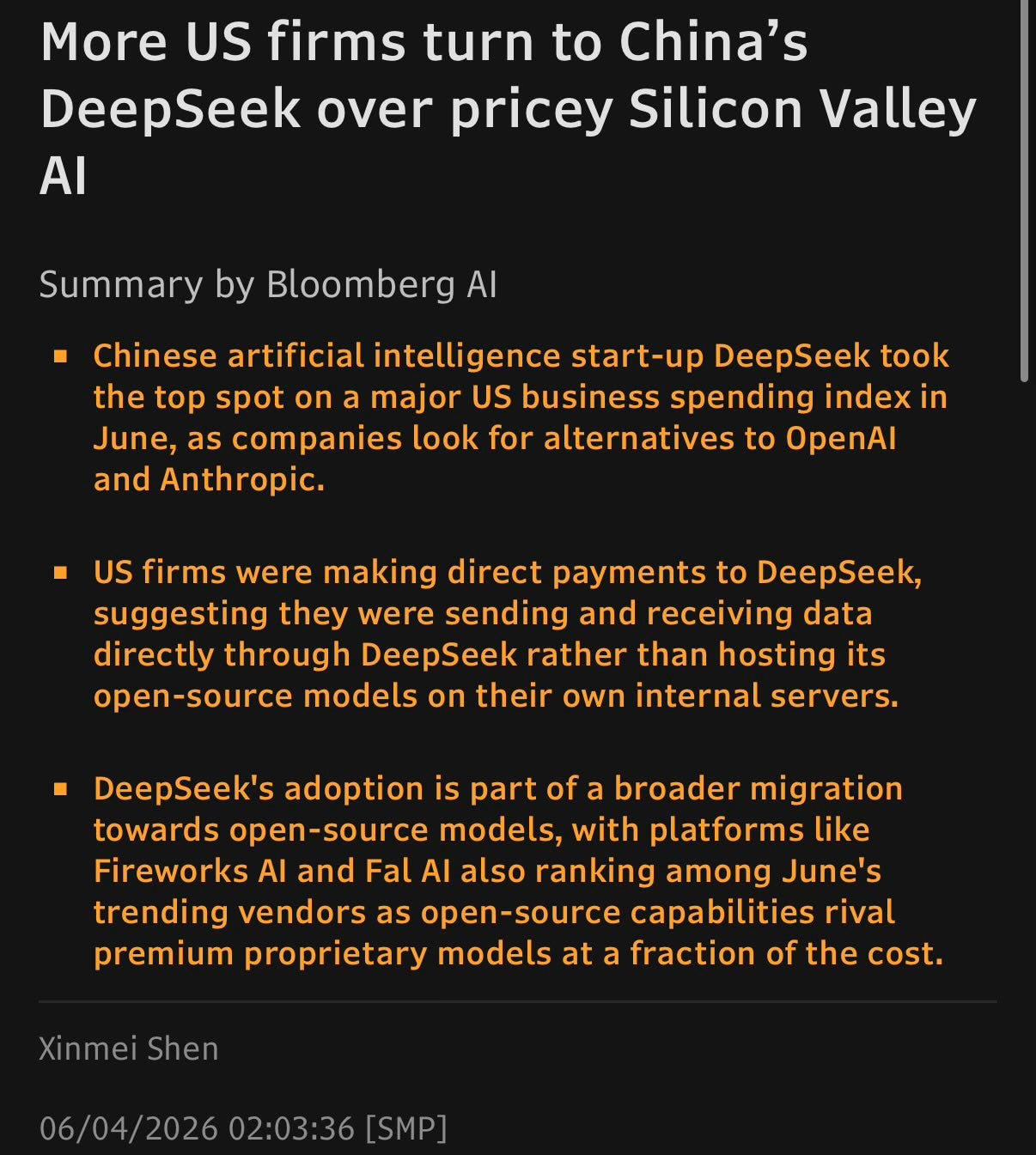
While the West obsesses over AI stock valuations—profitability can wait—China has chosen a far wiser and more disciplined path. Instead of crippling its own industry with unsustainable electricity prices driven by the voracious appetite of data centers, along with every other negative externality (soaring costs of critical raw materials like copper and beyond), Beijing has focused on developing open-source AI models that require far fewer resources and are dramatically cheaper to run.
Now for a darker theory. Who remembers Ronald Reagan’s “Strategic Defense Initiative” in the 1980s, better known as Star Wars? It was a masterful psychological operation that lured the Soviet Union into pouring colossal resources into an arms race it could not afford—resources desperately needed elsewhere. Within less than a decade, that misallocation helped accelerate the USSR’s economic and then political collapse.
Is China now running the same playbook against the West with AI? By goading the West into flushing trillions into glittering infrastructure that delivers no returns and no productivity gains, while those monstrous data centers cannibalize the real economy, China is quietly locking in its industrial supremacy.
Read our lips, mark our words and make no mistake: the concommittant IPOs of Open AI, Anthropic and StarX merged with xAi are motivated by the fact that the credit crunch’s here, and that acquiring more capital for structurally loss-making businesses means going public. A nice way, too, to pass on capital losses to retail investors.
Constrat that with the European Commission’s pronouncements on its digital “sovereignty” plan and its appointment of a Davos fixture and Siemens chairman, Jim Hagemann Snabe — cozy with Google for years — and the picture becomes clear: not only are we nowhere near out of the woods, the EU will do everything in its power to keep us there.
AI as it is being sold to us is one gigantic con. See our series on the subject for the evidence.


We are republishing our article from January 26, 2025, in which we argued that China had just sunk American techno-capitalism. Time to take a small bow, since no one else will give us credit: we were right.
Proof: even Nvidia — the company supplying most of the “gold rush shovels,” meaning the GPUs that power AI systems — has just released its latest Nemotron 3 Ultra model as open-source.
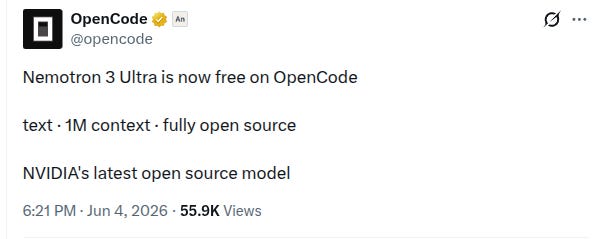
Open-source AI models are now abundant and perform close to on par with ChatGPT, Claude, MistralAI and their ilk. Enough to perform calculations that matters for business, mainly optimization.
You can simply pick one (or several) up, audit it, test it, and build proprietary applications on top of it at minimal cost. Why pay a premium to rent proprietary models — the same ones your competitors are using — that bleed your accounts dry without delivering any tangible return (as Uber recently discovered the hard way)? No wonder Dario Amodei, Anthropic’s CEO, is now calling for AI development to slow down or pause: Anthropic can’t keep up. No one can.
As for Mythos — for those who haven’t caught on — it’s a myth, a psychological operation designed to maintain the illusion that the US dominates the AI sector and for Anthropic a way to get back into the Pentagon game. Star Wars again. The real kicker: The U.S don’t have AI domination. No one does. The old world, in America as in Europe, refuses to die. Let’s help it along.

Originally published January 26, 2025
While OpenAI — the organization behind ChatGPT — is in the process of converting from a non-profit foundation to a for-profit corporation (note the audacity: a $6.6 billion donor-funded war chest quietly absorbed into a commercial entity) and is busy locking features behind proprietary walls, Chinese startup DeepSeek has just released the entire source code of its AI engine. It outperforms ChatGPT and costs 96% less to run — meaning it demands far less computing power, less electricity, less capital expenditure. Published under the MIT License, right as the Davos crowd assembled. The timing was not accidental.
To grasp the full weight of this development — a genuinely Copernican shift — you need to understand what open source actually is, and what an AI engine actually does.
Open source means making a software’s source code publicly available. Anyone can use it, and those with the skills can inspect it line by line, modify it, and improve it, provided they distribute their modifications under the same terms. This transparency is a security asset: bugs, vulnerabilities, and backdoors are caught and patched quickly. Open source is a bet on collective intelligence — consistently more effective than managerial hierarchy and its voracious, self-serving elitism.
The most famous open-source project is Linux, a kernel — the core software managing a computer’s hardware resources. Developed by Linus Torvalds, it spawned an ecosystem of distributions (Ubuntu, Debian, Fedora, and most notably Android, installed on 82% of smartphones worldwide) that are available at no cost. Where paid versions exist, you’re not buying a software license — you’re paying for maintenance services or supporting the development team.
Remember Windows NT and Lotus Domino Server? Those bloated, overpriced disasters that dominated server rooms in the 1990s and early 2000s? Linux killed them. Today, Linux commands over 80% market share in servers. The entire cloud runs on it.
That’s precisely why Microsoft, IBM and others pivoted to cloud infrastructure services. When Linux wiped out the server OS licensing market, the only money left to be made was in hosting, storage, and managed services.
An AI engine is not so different from an OS kernel. By open-sourcing DeepSeek, China has made it nearly impossible to monetize proprietary AI engine licenses — starting with ChatGPT. That is also why Elon Musk quietly made Grok free on X — it was behind a paywall just a month prior — to accelerate its training. As for Google’s Gemini, it is so riddled with bias and dysfunction that the Palo Alto giant appears to be in irreversible trouble.
This means one thing and one thing only: American predatory techno-capitalism in AI is already dead. The tech giants are finished. Donald Trump can spend $500 billion if he likes — it will change nothing, except to throw $500 billion out the window. Open-source engines are transparent, more secure, vastly cheaper, faster to develop, and offer a wider range of distributions and features. There is simply no rational case for the alternative.
There is another massive problem for the transatlantic techno-predators: the US has also fallen behind on hardware. The latest-generation chips required to run large-scale AI are now led by Taiwan and China. Nvidia, the only American semiconductor player in this space, will not hold. All the more so because DeepSeek runs on off-the-shelf chips — the kind you find in gaming graphics cards.
Europe? Hardly worth the question. The servile, compromised bureaucrats who run it would rather, in a bid to cling to relevance, impose Kafkaesque content regulations — as ineffectual as they are stifling — than address what actually matters: full digital sovereignty for every European citizen and every European nation over their data and infrastructure.
France alone holds thirty years of unified health data on its entire population, courtesy of the Carte Vitale system. Priceless. Without data, AI is worthless. So let’s continue allowing Americans to plunder it, with the full complicity of our leaders.
By open-sourcing DeepSeek, China has done humanity an enormous favor. Not our words — those of Marc Andreessen, towering figure of Silicon Valley and creator of Netscape, one of the first web browsers.

China’s AI lead did not materialize overnight. It was built through early, deliberate regulation of algorithms — imposing rights for users and duties for developers. Which throws a wrench into the worldview of Western “liberals” who recoil at any mention of regulation, confusing it reflexively with restriction.
[ Repub ] Progressivism, Big Tech, and Social Credit: Welcome to Feudal Society 2.0
![[ Repub ] Progressivism, Big Tech, and Social Credit: Welcome to Feudal Society 2.0](https://substackcdn.com/image/fetch/$s_!tOT1!,w_1300,h_650,c_fill,f_webp,q_auto:good,fl_progressive:steep,g_auto/https%3A%2F%2Fbucketeer-e05bbc84-baa3-437e-9518-adb32be77984.s3.amazonaws.com%2Fpublic%2Fimages%2F197cc51c-1ec5-442d-9b4d-2761acfd3167_1000x1000.jpeg)
To keep stirring the pot, we’re republishing our March 31, 2022 piece—where we explained why the so-called “Chinese social credit system” is mostly smoke and mirrors. There is no such thing in China as the Orwellian social credit system Western media keep describing.
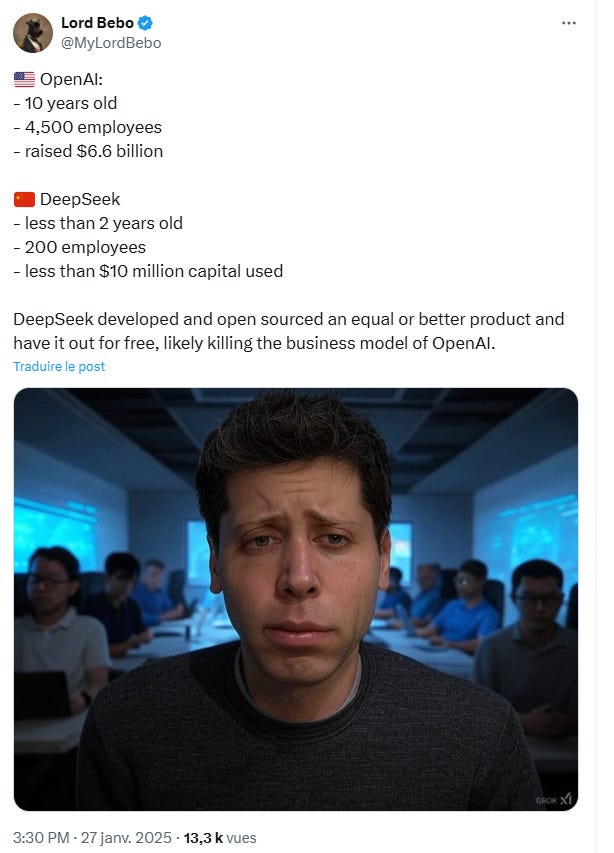
This is funny because not only is deepseek significantly worse than US models (or Mistral for that matter) but Beijing is in the process of forcing their models to be closed source, for the exact same fears the US has.
And if you think China destroyed predatory techno capitalism, then you clearly know little of how China operates. If anything they’ve perfected it