

From the Progressive Censorship Industrial Complex to the Zionist Censorship Industrial Complex
Has the neurosis merely switched sides, or are we drowning in a generalized ambient madness where every faction takes its turn wielding the censorship cudgel with the same victimhood-fueled hysteria?


American colleagues at Breaking Points have astutely pointed out how the progressive censorship industrial complex, rammed through much of the West since Barack Obama’s second term (peaking with Black Lives Matter and wokism’s apex under Joe Biden), now appears poised for replacement by a fresh censorship industrial complex justified under the banner of combating “antisemitism.”
Municipal police officers were dispatched to interrogate a woman over a social media post.
This is textbook intimidation—and perfectly illegal.
Sending detectives to a citizen’s door for expressing an opinion online represents a blatant abuse of power. It is not law enforcement; it is state-sponsored bullying.
Take the Anti-Defamation League in the US. Its CEO, Jonathan Greenblatt, boasts of deploying AI systems to instantly scan every reported “antisemitic” incident online, flagging “litigation opportunities” before funneling them to a sprawling pro-bono network of roughly 50,000 lawyers assembled from top firms. Victims—or rather, those accused—face referrals to authorities, employers, and lawsuits. This is little more than weaponized harassment dressed up as justice: a revamped cancel culture that achieves through social ostracism, economic ruin, and judicial pressure what the First Amendment prevents outright. The playbook mirrors the old progressive model precisely—stigmatize, exclude, and punish extralegally where statutes fall short.
In France, the pattern repeats with the proposed law against “renewed forms of antisemitism,” sponsored by Caroline Yadan Pesah (a Macronist Rep representing French citizens abroad; her constituency includes Israel) and recently greenlit by the Assemblée Nationale’s Law Commitee.
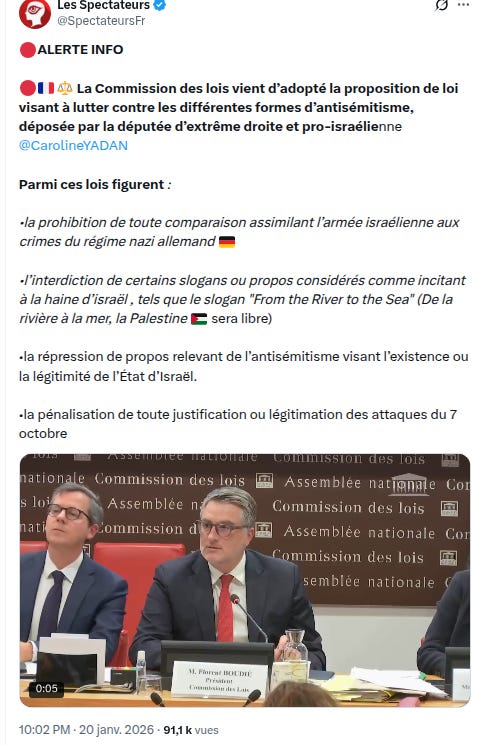
This proposed law stands on shaky constitutional ground and is highly likely to be struck down, either by France’s own Constitutional Council or by European courts.
French and European jurisprudence could not be clearer: freedom of expression is the bedrock rule, not the exception. Restrictions are permissible only for speech that is manifestly unlawful, backed by concrete evidence of incitement to hatred, violence, or discrimination. The European Court of Human Rights (ECHR) has repeatedly affirmed that even speech that shocks, offends, or disturbs—whether directed at the state, its policies, or segments of the population—enjoys robust protection under Article 10 of the European Convention on Human Rights. This includes sharp criticism of any government—including Israel’s—and calls questioning its policies or even its existence, provided they do not cross into direct incitement to violence.
The Yadan Pesah bill, in its original and even amended forms, risks precisely the overreach that courts routinely invalidate. By targeting so-called “renewed forms of antisemitism”—often framed around delegitimization, demonization, or calls related to Israel’s demise—it blurs the line between genuine hate speech and legitimate political speech. Opponents, including civil liberties groups, legal scholars, and NGOs like the Human Rights League and The Union of French Progressive Jews, have already labeled it illusory at best and a direct threat to free speech at worst. Even the Conseil d’Etat1 advisory opinion in 2025 flagged vagueness concerns that could doom it.
Should it somehow survive domestic scrutiny and pass into law, Strasbourg beckons. The ECHR has a long track record of censuring France when speech restrictions veer into disproportionate territory—most notably in cases involving criticism of foreign states or controversial historical/political debates. A blanket or overly broad criminalization here would almost certainly trigger condemnation for violating the proportionality test.
Consequently, as they’ve been doing since the 1920s—and as they did with the Pleven law in 1972 and the Gayssot laws in 1990 (France invented the censorhip industrial complex, as shown by the Twitter Files France)—certain factions are hell-bent on criminalizing whatever rubs them the wrong way. They’ll soon find themselves joined by other aggrieved minority groups, not necessarily their allies, in a hellish, neurotic whirl of legislation and litigation. After all, the convictions of Faurisson (Hollocaust denier), Soral (visceral antisemite), Zemmour (far-right anti-immigration politician), and their ilk haven’t exactly prompted any epiphanies or opinion reversals, have they?
If equating the Israeli army’s crimes with those of the Nazis becomes a felony, then it’s time to lock up every leftist who reflexively pulls the Godwin trigger to assassinate the character of anyone daring to disagree with them.
If chanting “From the river to the sea, Palestine will be free” warrants criminal charges, then haul in every advocate of Greater Israel, stretching from the river to the Sea.
If deeming the State of Israel illegitimate is now a prosecutable offense, then round up the Haredim—those ultra-Orthodox Jews who hold precisely that view.
Not a single soul in France’s political class has the spine to plainly define antisemitism. If we’re going to penalize it, that definition is non-negotiable.
Antisemitism means denying someone the rights that French society grants him, as to every other citizen, solely because he is Jewish. That’s already prohibited by law. It has zilch to do with judgments or opinions on conflicts raging on another continent, where France isn’t even a player.
Let’s cut the crap and shock the system, because we can, it’s protected by the ECHR jurisprudence. Socratic-style, but with no class: Israel is a shitty country. Here’s the proof: The majority of Jews don’t live in the land of milk and honey—and have zero plans to relocate there anytime soon, thus it is a shitty country. Ergo, Israel isn’t the homeland for all Jews. A third of its population isn’t Jewish, making it not a “Jewish state” but merely one with a Jewish majority. Israeli citizenship isn’t a religious litmus test, since not all Israelis are Jews. Unless we’re calling Israel a theocracy—which it damn well isn’t. Hey, we warned you it’d sting.
Does this scream failure for Zionism, that 19th-century ideology born as a retort to Europe’s nationalisms, which questioned oftentimes violently Jews’ loyalty to their birth nations? We conveniently forget that Herzl, Ben-Gurion, Jabotinsky, and their crew aimed only to carve out a national home in Palestine for Jews who wanted it. They never intended to mandate it as the default domain for every Jew on the planet, nor did they envisioned unconditional support to Israel as the mandatory proof of jewishness. Zionism’s ideological drift into the abyss is undeniable.

The question is indeed far more intricate than the simplistic binaries peddled today—and the French Revolution dissected it with ruthless clarity back in 1789–1791 (see the article below).

The principle articulated by Clermont-Tonnerre in 1789 applies with equal force today to Muslim, Buddhist, Hindu, or any other confessional communities in France. The state accords every right, protection, and civic participation to individuals regardless of faith; it refuses to recognize or accommodate any group as a separate “nation” with its own parallel rules, courts, or extraterritorial loyalties that might undermine republican unity.
This is precisely what underpins key provisions of French law on nationality, notably articles 23-7 and 23-8 of the Civil Code.
Article 23-7: A Frenchman who in practice behaves as the national of a foreign country can, if he also holds that country’s nationality, be declared by decree—after binding opinion from the Conseil d’État—to have forfeited French citizenship.
Article 23-8: A Frenchman loses French nationality if, while holding a position in a foreign army or public service, or in an international organization of which France is not (or is no longer) a member—or more broadly, by rendering them any form of assistance—he fails to resign the post or cease that assistance despite a formal government injunction to do so.
The individual will be declared, by decree in the Conseil d’Etat, to have lost French nationality if, within the deadline set by the injunction (which cannot be less than fifteen days nor more than two months), he has not ended his activity.
If the Conseil d’Etat opinion is unfavorable, the measure outlined above can only be taken by decree in the Council of Ministers.
Before piling on yet more layers of absurd and ultimately unenforceable legislation—layers that only bloat the statute book while poisoning social cohesion—why not simply enforce the laws already on the books that settled this debate decades ago?
Two crystal-clear examples suffice.
First: Every Frenchman enjoys the freedom to volunteer for military service in a foreign army. That liberty carries a non-negotiable legal consequence: loss of French nationality.
Second: Every Frenchman is free to support or sympathize with a foreign state. But cross into behaving in fact as a national of that foreign country while holding its nationality: French citizenship forfeited.
This isn’t about opinions, chants, criticisms of distant wars, or diaspora activism. It targets verifiable conduct showing France has become secondary.
These provisions draw the bright line perfectly: freedoms intact for individuals; zero tolerance for acts that subordinate French sovereignty to foreign allegiance, merely a way to make individuals cope with the consequences of their free choices. They prevent the importation of alien conflicts into France without trampling speech, belief, or private ties. No vague, overbroad “renewed antisemitism” bills required—no risk of ECoJ or ECHR smackdowns for disproportionate speech curbs.
The problem isn’t a lack of law; it’s a lack of spine to enforce what’s already there. Apply Articles 23-7 and 23-8 rigorously against concrete cases of foreign prioritization, and the supposed need for fresh censorship machinery evaporates. Those who truly prioritize another state’s interests over France’s can be separated—cleanly, legally, without ideological witch-hunts.
Problème réglé—if only the political class summoned the courage to use the tools the Republic already forged in 1791 and refined ever since. Until then, every new repressive layer is performative virtue that erodes freedoms while solving nothing.
France’s highest administrative court
Big Law Is Yet Another Problem
BY Brownstone Institute
https://brownstone.org/articles/big-law-is-yet-another-problem/