




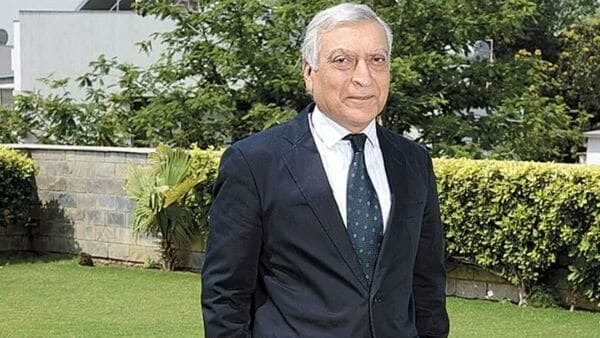
Guess what? The Earth ain't flat, and Paris ain’t its center of gravity either. We're republishing an interview with H.E. Kawlan Sibal that we conducted a year ago — what he had to say is still just as valid today. Better to listen to him than to any Parisian DJ.
Kanwal Sibal, president of Jawaharlal Nehru University in New Delhi and former Foreign Secretary of the Republic of India, offers his insights into the trajectory of global affairs.
Kanwal Sibal is well-positioned—not to patronize, but to provide clarity—having held ambassadorial posts in Egypt, Russia, and France before taking on Indian diplomacy's top job. He witnessed up close the peak of the Cold War, the short-lived perception of American hegemony, the similarly transient "globalist" neocolonial vision that emerged with globalization, and the initial negotiations of what would eventually evolve into the BRICS.
As an ailing European Union squanders what little geostrategic credibility it has left through irrational stances and policies, Kanwal Sibal’s words ring profoundly true.
With that characteristically subtle Indian candor, is he suggesting that we in the West are, in essence, “ullu da patha” (literally “sons of owls,” meaning fools)? That we’re incapable of sensing the winds of change—the breath of the Qalandar—while eagerly embracing a Hollywood-style Indiana Jones version of Kali? That, to our own detriment, we’ve stopped trying to understand the world?
India, as has long been evident, is a demographic titan. Today, it stands as an economic, industrial, scientific, technological, and military powerhouse—a major global player that steadfastly refuses to assert itself aggressively. These 1.4 billion non-aligned friends are intriguing.
So let’s move beyond trading-post chatter in Pondichéry and listen to how we’re perceived—especially since, in India, no one harbors ill will toward the West. Our 1.4 billion non-aligned friends remain undeniably intriguing.
L'Eclaireur : Good morning, sir. Thank you so much for taking the time to speak with me. You were just in Moscow, I believe, last week. What was the atmosphere in the Russian capital?
Kanwal Sibal : Well, it seemed pretty normal. We had this conference, which was very well attended, huge crowds. We went around and walked a little bit—some of the old places where I used to walk before, obviously the Red Square and the area around. And generally, of course, we motored through large parts of Moscow because I had appointments here and there. So sitting there, you wouldn't get the impression that there is a war going on.
Though, of course, I must say that many of the Western shops which were there—let's say in GUM—they have bound up. You don't see them, whether it is French or German or Italian. Chinese presence is very prominent in GUM. There are a few Italian companies I wasn't familiar with that have taken the place of the Western companies that have departed.
To answer your question, the restaurants are full, the streets are full of traffic. I was told that Chinese vehicles have replaced the German cars and that you would not see Mercedes or BMWs or others. But I was a bit surprised—that’s not quite true. In fact, most of the cars I saw on the street, some of them are German, but there are also Japanese cars—Toyota and others.
Another thing I noticed was that, driving from the airport, you could see on the right side a whole line of Western auto showrooms. Now most of them, virtually all of them, have been replaced by Chinese car showrooms. Also, since I visited after some years, I saw many more high-rise modern buildings from the airport to the center. In the business district in Moscow, you see more skyscrapers. But in the heart—where you have the Red Square, the Bolshoi, and all that—things seem to be the same.
L'Eclaireur: So business as usual, I would say. Okay, what is your take on the bloody mess that is going on in Europe right now? I mean, from an Indian perspective—which is a perspective that unfortunately we do not hear much of back here in Europe—while I believe it is absolutely critical.
Kanwal Sibal: Well, if you ask me frankly, it's very difficult to understand why Europe is doing what it is doing. In the sense that Europe has always prided itself—and until recently quite legitimately—on having overcome the enmities of the past. Europe was a haven of peace, a value proposition rather than a security proposition. The security issues had largely been settled between European countries, and the wars and enmities of the past had been overcome.
Europe was in the business of projecting to the world its commitment to peace, social harmony, and welfare—a stable and peaceful world order. But now, Europe’s calling card as a haven of peace lacks credibility altogether.
Because when Trump, for whatever reason, is looking for some way out of the conflict—trying to end the conflict, reach out to Russia, promote a peaceful solution—Europe is doing its very best to prevent that from happening. They want to prolong the conflict, and they have not moved away at all from their previous rhetoric about Russia being a danger to Europe. In fact, they’ve aggravated that narrative by claiming that if Russia succeeds in Ukraine, the next target will be either Poland or the Baltic states—even Western Europe.
That’s the kind of narrative. They are fully supporting Zelensky, even when he has lost credibility—not only in America, but certainly in the Global South—because of his rhetoric, his changeability, his unpredictability, and his determination to push Europe and the United States into a much wider conflict with Russia, to the point of even risking a third world war. He has not changed that position at all. In fact, his rhetoric is becoming more and more unhindered.
And more than that, if you have at the head of Europe in the European Union people like Von der Leyen, Kaja Kallas, or that defense chief from Lithuania—these are diehard, diehard anti-Russian personalities.
How can you think about Europe taking initiatives for peace if these are the people in charge of the European Union in Brussels? Then you have the Danish Prime Minister, already threatened by Trump's America over Greenland, saying that war in Ukraine is safer than peace in Ukraine. Because they feel that if the United States manages to promote some kind of solution and Europe is left out, Europe will be finished geopolitically.
Now, from an external perspective, they want to increase their defense budgets and military capacities — all this while their economies are struggling, with many countries heavily indebted. But even if you want to build up military capacity, it can’t happen overnight. It’ll take years to establish a production base and raise armed forces to credible levels.
And what happens if tomorrow, or the day after, there is some kind of resolution to the Ukraine conflict? Then the entire premise behind this militarization of Europe — which assumes a permanent hostility with Russia — is undermined. This is already evident in the fact that the UK signed a 100-year security agreement with Ukraine. That implies they don’t foresee normal, friendly ties with Russia for the next century.
If peace gains traction, how will they justify this rise in defense spending, especially when it impacts social spending? There are already social tensions on the ground.
What’s more disturbing is the betrayal of Europe’s own values. Europe once prided itself on representing values on which global governance should be anchored — spreading those values globally. But now they’ve taken steps totally opposed to those values. There’s censorship. Russian media isn’t allowed to be broadcast in Europe.
Why is Europe afraid? Even if there’s propaganda from the Russian side, shouldn't they have confidence in their public’s maturity to distinguish facts from propaganda? It’s supposed to be about free speech, about allowing dissent and opposing views. In France, for example, far-left or far-right positions that don’t align with Macron’s are tolerated — and that diversity shapes the political system.
There is lawfare happening across the continent. Take Romania — they banned the leading candidate, the likely winner of the election. He’s not even allowed to run. In Georgia, they’re doing everything they can to destabilize the ruling party. The President of Georgia, who is of French origin, played a role that, at least from the outside, doesn’t seem to follow the best constitutional practices. Something similar is going on in Moldova.
In Serbia, there’s a clear effort to create a regime change scenario — like a Maidan-style uprising. In Slovakia, there was an attempt on the life of Prime Minister Fico, who holds very sober views on de-escalation and peace in Europe. And then there’s Viktor Orbán, who has consistently advocated for dialogue and diplomacy with Russia. He is constantly attacked.
In a recent vote on aid to Ukraine, Orbán voted against it — and the principle of consensus was completely ignored. His vote was simply discarded as meaningless.
Europe has taken other questionable actions too — like confiscating Russia’s foreign exchange reserves. They claim they won’t touch the principal, but they’re using the interest earned from those reserves to finance weapons and Ukraine’s reconstruction. To outsiders, this doesn’t make sense. If the principal can’t be confiscated, how can the interest be taken? It simply doesn’t add up.
L’Eclaireur: I don’t know if you saw what happened to Marine Le Pen today.
They’re doing it another way now — lawfare. There’s a lot of it going on.
But when we talk about Europe — what do we actually mean? Are we talking about the EU? And by EU, do we mean the European institutions like the Commission? Because von der Leyen essentially is the Commission.
Let me be a bit provocative — would anything be different if there were no supranational EU? Isn’t the EU basically just a subsidiary of NATO ?
Kanwal Sibal: Well, you know, of course, I’m not speaking as an analyst. But at the official level, India’s policy and approach is somewhat different. We see significant value in maintaining strong ties with Europe, and we are actively trying to expand those ties. A few weeks ago, Ursula von der Leyen came to India with 22 of the 27 EU commissioners to deepen trade relations and broaden our overall relationship with Europe. We're also negotiating a Free Trade Agreement (FTA) with the EU.
We believe Europe has an important role to play in international politics and in maintaining a global balance of power. If Europe is weakened beyond a certain point, it would be a loss to the international community. After all, with a population of around 450–460 million, Europe represents a massive consumption market due to its high standards of living. It’s also a key source of advanced technology—even though it's spread across various countries rather than centralized.
Europe also has considerable military strength. Individual countries like France and the UK have nuclear capabilities and produce high-quality defense products—Airbus, BAE, and so on. Furthermore, in global negotiations—be it on climate change, SDG goals, or UN reform—Europe’s cooperation is indispensable.
However, Europe seems to be becoming its own worst enemy. It is losing ground in terms of reputation, especially in the Global South.
Now, coming to your question, there are two things. First, yes, there is a debate that bureaucrats in Brussels are taking on too much authority—perhaps even beyond their mandate. I’m not a scholar of the EU constitution, but it appears that some decisions, like spending on defense and allocating defense budgets, are being made at the EU level, which may not fall within their legal remit.
L’Eclaireur : All defense matters are definitely not EU competencies. Exactly. That’s why the idea of an EU Commissioner for Defense is odd—the position doesn’t even exist.
These people have lost all contact with reality. They’re not even focused on defeating Russia anymore. It seems more like they’re just clinging to power and trying to prevent European institutions from crumbling, because they’re becoming increasingly unpopular with the public.
Kanwal Sibal : Yes, that’s why I said the EU is arrogating too much power to itself. Unfortunately, even sovereign European countries are now adopting positions that don’t help their reputations. Take Germany, for example. From Chancellor Scholz to the current leadership, the rhetoric and postures have been surprisingly aggressive. I had assumed, given Germany’s history, they would be cautious about their weapons being used to kill Russians again. But now, the new chancellor is even threatening more confrontation.
As for France, I’ve always respected its foreign policy, but President Macron’s hardline stance is surprising. He, along with leaders like Starmer, seems to be leading the charge against Russia, pushing for European armed forces to coordinate potential operations. When they talk about sending peacekeeping forces, they know full well Russia has categorically rejected the idea of NATO forces—so-called peacekeepers—being sent to Ukraine. Russia’s UN ambassador said it just days ago, yet Europe persists, with Macron even stating they’re operationalizing that decision. Meetings between defense chiefs are already taking place to plan this out.
This kind of initiative—especially from France, Germany, and the UK—leaves me puzzled. What exactly are they hoping to achieve? When the U.S. and Europe were united under the Biden administration to strategically defeat Russia, they didn’t succeed. How does Europe now think it can accomplish this without the U.S.? It’s simply not possible.
The other issue is that figures like Ursula von der Leyen and Kaja Kallas didn’t get into power on their own—they were backed by major European countries. Leaders from small Baltic states like Estonia have been given disproportionate influence in Brussels. These countries have small populations, limited global exposure, and no tradition in international affairs or geopolitical nuance. Their fears of Russia may be understandable, given historical experiences during the Soviet era, but such fears—or phobias—should not be the foundation of Europe’s foreign policy.
Even countries like Poland cannot be expected to maintain a balanced, long-term approach to Russia due to their own historical baggage. So it's perplexing to outsiders why Europe is going down this road. When Trump was in office and appeared willing to engage with Russia to find a resolution to the Ukraine conflict, I thought Europe would take the opportunity to cut its losses and join the initiative diplomatically. It would’ve been a convenient political cover.
Instead, Europe is now talking about separating from the United States and going it alone—building independent defense capabilities at a time when their economies are struggling. On top of that, we might even see trade conflicts, tariff wars between Europe and the U.S., which will harm both sides.
And where Trump has made it very, very clear that Ukraine is not going to join NATO, and they are not going to get involved in any conflict with Russia over Ukraine. I thought that this was a good enough signal for them to actually tone down the rhetoric and try and shape a different narrative which would be supportive of the general idea of finding some solution to the conflict, rather than this posturing of going it alone, which nobody thinks is credible.
L'Eclaireur : Well, there may be another explanation for that. The European Union is trying to increase its competencies through crisis and through what we call competency creep, which is usually what bureaucracies which are not kept at bay do. And that's also one of the explanations which are set forth. Is India still an unaligned country?
Kanwal Sibal : Yes, we are, in the sense that we have maintained our ties with Russia, even though we were put under great pressure by the Biden administration and by Europe. In fact, when von der Leyen came here about three years ago, she lectured us on how we were on the wrong side of history and how it was morally imperative for India to side with Ukraine and condemn Russian aggression. They were very unhappy that we were abstaining in the UN Security Council and UNGA votes and that we were buying oil from Russia. But this time when she came, the narrative was totally different.
L'Eclaireur : But she might have figured out that the oil that you bought from Russia was refined in India and sold back to us as much needed fuel.
Kanwal Sibal : Yes, that is there. But apart from that, now I find that even a paper like The Economist, which is traditionally very biased and critical of India, has actually in a recent article praised India's policy — that India has been able to maintain ties with both sides and has been very successful in its diplomacy, and that others needed to emulate that. But leave that aside. At the same time, we maintained very good ties with the Biden administration. And over time, they ceased talking to us about pressures to reduce ties with Russia.
Even on the oil trade, I can share with you something which you may already know — that the outgoing U.S. ambassador to India, at a public function here, said that the U.S. had advised India to continue to buy Russian oil because that would keep the prices down internationally and help the U.S. consumer. And so there are wheels within wheels. I don't think this was the case at all. We took an independent decision. But leave this aside. During the four years of the Biden administration, our relations with the U.S. government expanded a great deal.
So we had good relations with the United States, good relations with Russia, good relations with Europe, and we've kept our doors open to China. China is now maybe the second largest trading partner in goods — $130 billion of trade — even as our forces are confronting each other on the border. And we've kept that door open because it increases our options. If we were to burn our boats with China, then we'll become much more vulnerable in terms of pressures from other quarters.
But at the same time, we are also participating in efforts to deter China — either through the Quad or the Indo-Pacific or our very strong relations with Japan and with the Philippines. In fact, we have given some very advanced missiles to the Philippines. So I think so far we have managed to play this balancing game where, in pursuit of our stated foreign policy objective of being friendly with all countries, we have been reasonably successful.
L'Eclaireur : Including with Pakistan, by the way, which is...?
Kanwal Sibal: Not with Pakistan.
L'Eclaireur: Not with Pakistan, okay (laughters).
Kanwal Sibal : No, no, no. With Pakistan, it's different. Pakistan is sort of half imploding. As you know, they are in huge difficulty internally. It is a total mess. Their politics is a total mess. But what has made that mess even messier is the whole strategic objective of propelling the Taliban into power in Afghanistan. So in that situation, Pakistan is not at the moment a problem.
Even the China-Pakistan Economic Corridor and Gwadar have had great difficulty because of the Balochistan Liberation Front — which is attacking Chinese workers, sometimes with Pakistani soldiers. So even that project has stalled, which was a headache for us. So in that sense, Pakistan has been ignored by us. Otherwise, the situation on the border is relatively quiet — in the sense that Pakistan is so embroiled in its own difficulties that it has little time to promote terrorism in India, though here and there they continue to do mischief.
L'Eclaireur : What about India and Africa, which has strong ties that have been developed over the past 30 years or so?
Kanwal Sibal : No, actually longer than that. Right from the start, after we became independent, we broke our relations with South Africa because of apartheid. We supported Nelson Mandela and politically supported the liberation movements of Africa. I myself served in Tanzania and met at that time Mugabe, Sam Nujoma, and others. But we were giving them political support in the Non-Aligned Movement and in the United Nations.
We have had strong Indian communities in East Africa, particularly in Kenya and Tanzania. So they have been the instrument for our activity there on all fronts. We've had very strong traditional ties with Ethiopia. In fact, we set up the first military academy in Sudan. With Ethiopia, we've had outstanding ties and helped them in many ways.
Now in West Africa, our companies have been very active. Our telecom companies, in particular, have been active, as well as our IT companies. We have some very well-funded training programs for African bureaucrats, and many of them have been trained in India over the years.
Now I find that even a paper like The Economist, which is traditionally very biased and critical of India, has actually praised India's policy — that India has been able to maintain ties with both sides and has been very successful in its diplomacy and that others needed to emulate that.
At the same time, we maintained very good ties with the Biden administration. Over time, they ceased talking to us about pressures to reduce ties with Russia. Even on the oil trade, the outgoing U.S. ambassador to India said at a public function that the U.S. had advised India to continue to buy Russian oil because that would help keep prices down internationally and benefit the U.S. consumer. So there are wheels within wheels. I don't think this was the case at all — we took an independent decision.
During the four years of the Biden administration, our relations with the U.S. government expanded a great deal. So we had good relations with the United States, good relations with Russia, good relations with Europe, and we've kept our doors open to China. China is now maybe the second-largest trading partner in goods — $130 billion of trade — even as our forces are confronting each other on the border. We've kept that door open because it increases our options. If we were to burn our boats with China, we’d become much more vulnerable to pressures from other quarters.
At the same time, we are also participating in efforts to deter China, either through the Quad or the Indo-Pacific or our very strong relations with Japan and the Philippines. In fact, we have given some very advanced missiles to the Philippines. So far, we have managed to play this balancing game where, in pursuit of our stated foreign policy objective of being friendly with all countries, we have been reasonably successful.
With Pakistan, it's different. Pakistan is sort of half imploding. They are in huge difficulty internally — it’s a total mess, especially politically. What has made that mess even messier is the strategic objective of propelling the Taliban into power in Afghanistan. So in that situation, Pakistan is not at the moment a problem. Even the China-Pakistan Economic Corridor and Gwadar have had great difficulty because of the Balochistan Liberation Front, with Pakistani soldiers attacking Chinese workers. That project has stalled, which was a headache for us. In that sense, Pakistan has been ignored by us.
The situation on the border is relatively quiet because Pakistan is so embroiled in its own difficulties, it has little time to promote terrorism in India — though here and there, they continue to do mischief.
As for Africa, our ties are long-standing. After we became independent, we broke our relations with South Africa because of apartheid. We supported Nelson Mandela and the liberation movements of Africa politically. I served in Tanzania and met leaders like Mugabe and Sam Nujoma. We supported them politically in the Non-Aligned Movement and the United Nations. We also have strong Indian communities in East Africa, especially Kenya and Tanzania. They have been instrumental in our activities on all fronts.
We have had very strong traditional ties with Ethiopia. We helped them in many ways. We even set up the first military academy in Sudan. Now in West Africa, our companies have been very active — especially our telecom and IT companies. We also run well-funded training programs for African bureaucrats; many have been trained in India over the years.
However, China has penetrated Africa so much that they have outdistanced us. If you compare China's activities in Africa with ours, there is clearly an imbalance — even though we preceded China in our cooperation with Africa by many years. But our approach is different. We do projects that Africans genuinely want. We assess their needs and provide accordingly, rather than using platforms like the BRI to offload excess capacities, as China does in infrastructure and other areas.
India’s approach is more human-centric, with greater willingness to transfer technology. We’re very active in the health sector — 40% of the generic drugs that America buys are from India. Indian generics are also very popular in Africa.
On the question of a multipolar world: I was involved in the RIC — the Russia-India-China dialogue — when I was Foreign Secretary. That initiative came from Mr. Primakov during the unilateralist phase of U.S. foreign policy, particularly around Iraq. The idea was that if Russia, India, and China came together, it could act as a bulwark against U.S. unilateralism. That didn’t quite go as planned because India-China relations remain difficult and we don't trust the Chinese. Still, the platform existed.
Then BRICS expanded to include Brazil to give it a more continental spread, and later China brought South Africa into the fold — not because it fit the metrics of an emerging economy, but for political reasons. Now you have five more countries joining BRICS, largely from the Middle East — Iran, Egypt, Indonesia, Ethiopia, etc. Many others have become associate members.
All these countries are hedging their bets. They don't want to be dominated by the West. They seek ties with non-Western countries to increase their room for maneuver on the global stage.
On the G20: it's a forum where G7 countries and major emerging economies work together. India has been extremely active and successful in shifting the G20 agenda away from G7 priorities toward the concerns of the Global South. In a sense, this is a contribution to multipolarity — recognizing that global issues can’t be dealt with solely from the perspective of developed countries.
China has penetrated Africa so much that they have outdistanced us. If you compare China's activities in Africa and ours, then there is clearly some sort of imbalance where we've not been able to do as much, despite the fact that we preceded China in our cooperation with Africa by many years.
But our entire approach to Africa is very different. We genuinely do projects which the Africans want. We see what their needs are and give them what they want, rather than using, like China does, the BRI for finding markets for their excess capacities in infrastructure building and other areas. The Chinese are very good at that, but they do it in a different way—finding markets for themselves to create outlets for excess capacity.
India is not pursuing that policy. It is a much more human-centric approach with greater willingness to transfer technology. On the health sector, we are very active because we have strengthened that area. You know, 40% of the generic drugs that America buys are from India. And generic Indian drugs in Africa are needed and very popular. That’s another area in which we are strong.
Well, you know, I was associated, when I was in service as the foreign secretary, with the RIC—the Russia-India-China Dialogue. The inspiration for that came from Mr. Primakov, the Prime Minister of Russia. That was during the unilateralist phase of US foreign policy—like in Iraq and other cases. The idea was that if Russia, India, and China got together, it could be a bulwark against US unilateralism.
That didn’t work as planned because India-China relations continue to be difficult, and we don't trust the Chinese. Nevertheless, the platform existed. It was later enlarged into BRIC with the inclusion of Brazil, to give it a more continental spread. China then brought South Africa into BRICS because their biggest partner in Africa was South Africa, even though it didn’t measure up to the economic metrics of emerging economies. But it was included for political reasons.
Now, you have an additional five countries joining BRICS, largely from the Middle East—like Iran, Egypt, and also Indonesia and Ethiopia. Many other countries have become associate members. All these countries are hedging their bets. They don’t want to be dominated by the West. They want to establish ties with non-Western countries to gain more room on the international stage.
Then you have the G20, where the G7 countries and major emerging economies from non-Western countries work together. India has been extremely active and has succeeded in shifting the G20 agenda from that of the G7 to the agenda of the Global South. This contributes to multipolarity by recognizing that global issues cannot be handled solely from the perspective of developed countries. The focus should now be on the concerns and priorities of developing countries.
This is the broader agenda of BRICS and the multipolar world. It’s a good and realistic objective, given the current distribution of power and the decline of Western hegemony. However, to imagine a truly multipolar world is a bit of a stretch.
Russia, formerly the Soviet Union, was considered a pole. After the Soviet collapse, Russia's power declined, but it still considers itself a pole—and justifiably so. Countries in Central Asia, Africa, and others look up to Russia. It’s a permanent member of the UN Security Council, so it has influence.
China is a pole due to two reasons—its permanent membership of the Security Council and its economic policies through the BRI. It’s the largest manufacturing power and the biggest exporter in the world.
India is not a permanent member of the Security Council. We have a difficult periphery and are not fully able to control it. Still, we are a voice of the Global South, which gives us prestige. But we’re not yet a pole in the sense that others will follow our lead, though on specific issues, some countries may align with us because we articulate their interests well.
We are a growing economy—already the fifth largest—and by 2030, or earlier, we’ll overtake Germany to become the third largest. That increases our international value, politically and economically. So, vaguely speaking, India will become some sort of a “half-pole,” where we’re courted by the West, the Global South, Russia, and China—who all see India as a valuable market, though we keep them out to some extent.
Japan was once touted as a pole, but I don’t see it becoming one. Japan’s security is completely dependent on the United States, unlike India, which isn’t under any security umbrella. That gives us independent prestige.
For Russia and China, a multipolar world is essentially anti-West—against Western domination and hegemony. The US treats Russia and China as adversaries, and the EU treats Russia as an enemy and China as a systemic rival. India, however, has excellent relations with the US, Europe, and Russia.
So for us, a multipolar world is not anti-Western. It’s about recognizing our legitimate aspiration to play a greater role in global governance. We need more space at the global level, which requires a dilution of old or new hegemonies.
That’s why we’ve said—repeatedly—that before we talk about a multipolar world, we must first have a multipolar Asia. And the meaning of this is clear.


